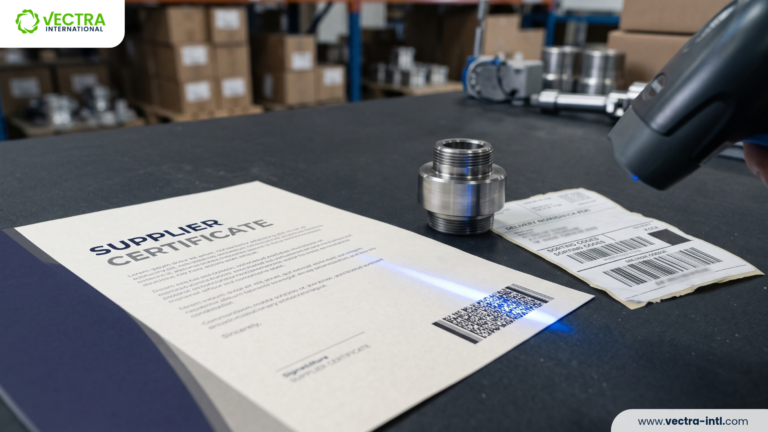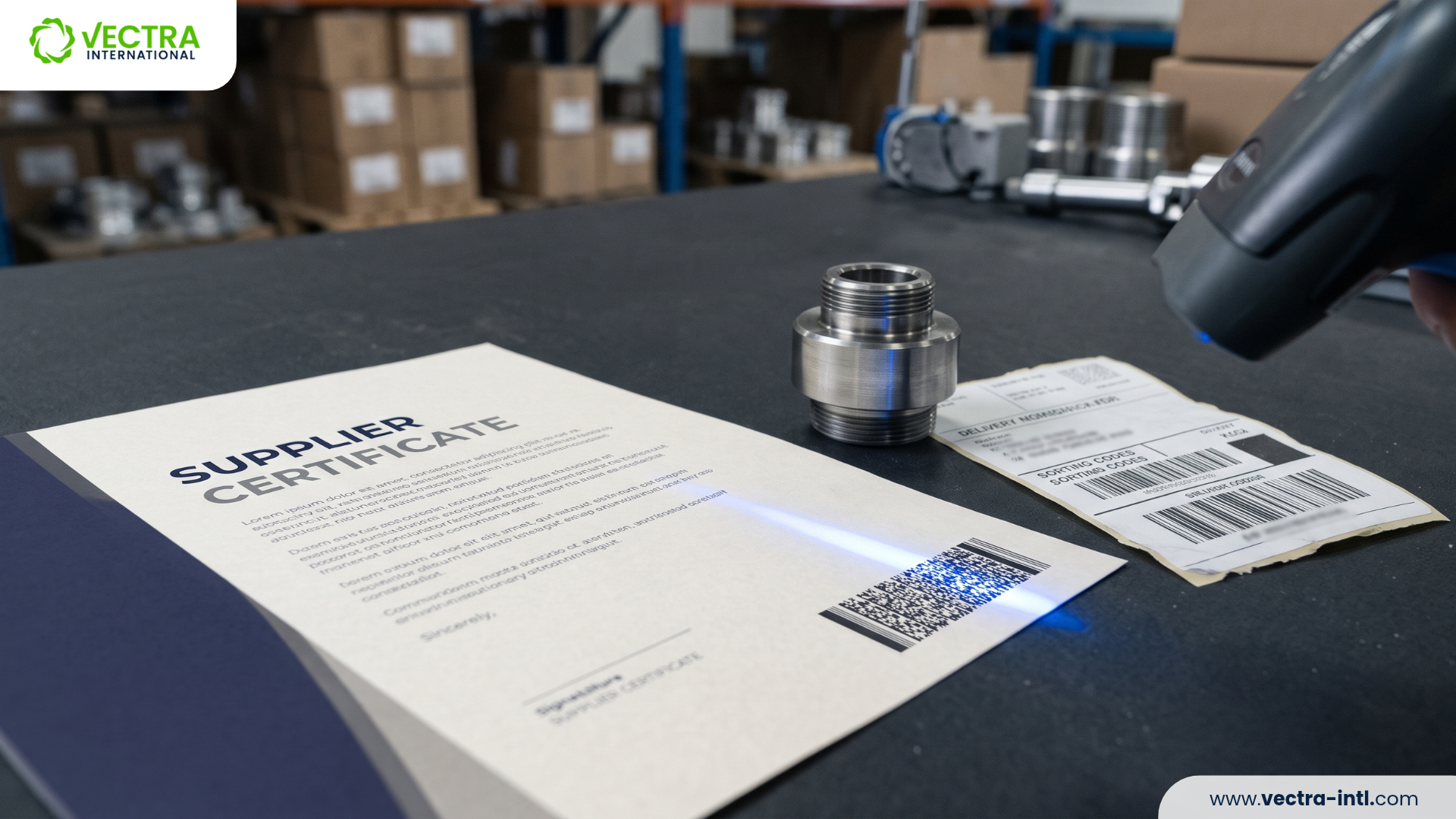
ISO 25500-110:2026 gives digital supply-chain systems a consistent way to ask whether a certificate can be verified, retrieve the dataset behind it, or find its identifier using the recipient’s name. Published on 4th November 2026, the standard addresses the request-and-response layer for certificate data. It does not decide whether a certificate proves that a supplier, site, product, or process meets your requirement.
That distinction matters. A successful technical response can establish that an identifier or certificate record exists and can be resolved through the relevant system. Your procurement, quality, compliance, and due diligence teams must still evaluate the certificate’s status, scope, issuer, recipient, covered site or item, dates, and relevance to the decision being made.
What Does ISO 25500-110:2026 Actually Standardize?
The standard covers three types of request. Each has a different purpose, and confusing them can create a false sense of assurance.
| Request | Question answered | Typical input | Useful outcome |
| Verify | Can the certificate identifier be verified through the relevant system? | Certificate identifier formatted in line with ISO 8000-115 | A structured verification response that can support an automated check |
| Resolve | What certificate dataset is connected to the identifier? | The certificate identifier | The dataset needed to review fields such as recipient, issuer, scope, status, and dates, where available |
| Search | Which certificate identifier is connected to this recipient? | Certificate recipient’s name | A route to find the relevant identifier before verification or resolution |
The identifier format is tied to ISO 8000-115:2024, which sets requirements for quality identifiers used in master-data exchange. In plain language, the identifier needs to point unambiguously to the responsible issuer and the data it represents.
What Does the Standard Not Prove?
A machine-readable response improves access to evidence. It does not turn every certificate into sufficient evidence or make the underlying decision for you.
Validity and scope. Your team must still determine whether the certificate came through a competent and appropriately accredited process and whether it covers the correct supplier entity, site, product, service, process, and period.
Status and rigor. Verification does not establish that the certificate is current, unrestricted, or supported by an assessment rigorous enough for the risk. It also does not prove that the supplier’s controls continue to operate effectively after certification.
Reliance and responsibility. You must decide whether reliance satisfies the applicable law, contract, customer requirement, or internal approval rule. The standard also leaves the issuing entity’s method for resolving certificate records outside its stated scope.
This is consistent with VECTRA’s supplier risk assessment checklist: a valid certificate may support an assessment, but it does not prove that every relevant site, process, product, or location is controlled.
Why Does Supply Chain Certificate Verification Matter?
Supplier certificates are often handled as attachments. A supplier uploads a PDF, a buyer checks that something appears to be present, and the file sits unchanged until the next onboarding or audit cycle. That approach can miss expired records, altered documents, mismatched legal entities, incomplete scope, unapproved site changes, or a certificate that was never relevant to the purchased item.
Structured requests can move part of the process from document collection to controlled data exchange. They can help systems ask the same question in the same way, store the returned fields, and trigger a review when a response is missing or changes. This can reduce manual searching, but only if the data is connected to the business decision.
For example, a certificate check during supplier onboarding should be tied to the exact supplier entity, manufacturing site, supplied product or service, approval condition, and review date. A result stored only against the supplier’s general profile may still leave the purchase decision unsupported.
How Should You Add the Standard to Supplier Controls?
Do not begin with an API project. Begin with the decision that depends on the certificate. The following sequence keeps the technical work tied to risk and evidence.
1. Define the controlled decision. State whether the certificate supports initial approval, product release, market access, tender qualification, site authorization, ongoing monitoring, or another decision. Different decisions require different fields and tolerances.
2. Identify the required certificate and authoritative source. Record the standard or scheme, acceptable issuer or accreditation conditions, recipient, covered site or item, required status, relevant dates, and the source your team recognizes as authoritative.
3. Choose the correct request. Use search when the identifier is unknown, verify when you need to check an identifier, and resolve when the decision requires the dataset behind it. Do not use a successful identifier check as a substitute for reviewing the dataset.
4. Match the response to master data. Compare the returned recipient, issuer, identifier, site, item, scope, and dates with controlled supplier and purchasing records. Define how name variations, mergers, parent companies, and trading names will be handled.
5. Set exception and escalation rules. Specify what happens when a record cannot be found, several matches appear, a field conflicts with the supplier record, a certificate is inactive, or the verification service is unavailable.
6. Retain the evidence trail. Store the request, source, response, timestamp, matched entity or item, reviewer or automated rule, decision, and any limitation. A current screen result without a retained decision trail may not support a later audit or dispute.
7. Monitor changes according to risk. Refresh the check at a defined interval and when significant events occur, such as renewal, site change, product change, new subcontracting, incident, ownership change, or adverse audit finding.
What Should You Ask a Platform or Technology Provider?
The standard can support interoperability, but implementation quality still depends on the source data, integration, identity matching, security, and exception handling. Ask providers to demonstrate the following:
· Coverage and function: supported schemes, issuers, accreditation systems, countries, and sources; whether verify, resolve, and search are handled separately; and which returned fields are preserved.
· Identity and results: how identifiers and names are matched to supplier, site, product, and legal-entity records, and how the platform distinguishes missing, unavailable, multiple, expired, suspended, or withdrawn results.
· Evidence and security: how sources, timestamps, responses, changes, actions, and overrides are retained, and which access, encryption, logging, retention, and incident-response controls protect the data.
· Exceptions and portability: how false matches, disputed results, issuer corrections, and manual fallback are handled, and whether the complete evidence and decision history can be exported.
How Should You Handle Failed or Ambiguous Results?
A failed automated check is not automatically evidence of supplier misconduct. It is an exception that needs a defined response. Treat different outcomes differently.
| Result | What it may mean | Proportionate response |
| Verified and resolved | The record can be located and returned | Review status, scope, recipient, site or item, dates, issuer, and relevance before approval |
| Identifier not verified | Incorrect identifier, unsupported source, inactive record, or a genuine concern | Check transcription and source; request issuer evidence; escalate if the certificate is decision-critical |
| No search match | Name variation, incomplete coverage, missing record, or no certificate | Confirm the legal entity and aliases; search the authoritative register; ask the supplier for the identifier and issuer |
| Multiple matches | Several certificates or entities share similar names | Match legal identity, address, site, scheme, item, scope, and dates before selecting a record |
| Conflicting fields | The uploaded document and source record do not agree | Pause reliance, retain both versions, contact the issuer or responsible certification body, and document the resolution |
| Service unavailable | A technical failure rather than a certificate result | Use an approved manual route, record the limitation, and repeat the digital check within a defined period |
How Does Certificate Verification Fit With Audits and Assurance?
Certificate verification, supplier assessment, audit, and assurance answer different questions. Verification can confirm access to a certificate record. A supplier assessment evaluates risk or capability against a defined decision. An audit tests selected criteria against evidence. Assurance evaluates information or claims for intended users under a defined engagement.
VECTRA’s guide to independent assurance versus internal audit explains why the intended user and decision should determine the review method. The same principle applies here: increase the depth of checking when the certificate supports a high-consequence approval, legal claim, safety decision, market-access requirement, or public disclosure.
For accredited management-system certificates, tools such as IAF CertSearch can provide a practical source for checking certificate status, scope, certified locations, certification body, and accreditation body. That is a concrete verification route for certificates within its coverage. It should not be treated as a universal database for every certificate type or as proof that every operational requirement is being met.
What Should Procurement and Compliance Teams Do Now?
Start with a controlled pilot rather than a broad technology rollout. Select one certificate type that materially affects a supplier decision, one product or service category, and a manageable supplier group. Map the current evidence route from supplier submission to final approval, then test where verify, resolve, or search requests would reduce ambiguity or delay.
Record the decision and the minimum certificate fields required to support it. Confirm the authoritative verification source, assign ownership of exceptions, and test identity matching across supplier, site, product, and certificate records.
Before the pilot begins, define which outcomes lead to approval, conditional approval, additional evidence, or rejection. Compare manual effort, unresolved cases, false matches, expired records, and time to decision before and after the pilot so the team can judge whether the control has improved.
If the pilot exposes wider weaknesses in evidence ownership, risk segmentation, or monitoring, VECTRA’s Compliance, Risk & Due Diligence service can help connect certificate controls to supplier risk, mitigation, and reporting. Where the issue is readiness for certification or an external review, VECTRA’s Pre & Post Audit Assistance provides a route for gap analysis, corrective action, and audit preparation.
For teams building a shared foundation across procurement and compliance, the VECTRA Academy provides training and practical resources that can support policy, risk analysis, action, grievance management, and reporting.
The Decision Still Belongs to You
ISO 25500-110:2026 can make certificate data easier for supply-chain systems to request, find, and exchange. Its value is practical: fewer disconnected files, more consistent queries, clearer exception handling, and a stronger audit trail.
It does not remove the need for judgment. Before relying on any certificate, confirm the issuer, recipient, status, scope, covered site or item, dates, and connection to the decision. Then retain what was checked, what the result meant, who approved the outcome, and when the evidence must be refreshed. That is how technical interoperability becomes a useful control rather than another unchecked data field.
Summary
ISO 25500-110:2026 is best understood as a technical route for more consistent certificate queries, not as proof that every certificate is sufficient for a purchasing, compliance, or assurance decision.
Who: Procurement, supplier-quality, compliance, audit, due diligence, data, and technology teams; certificate issuers; platform providers; and organizations that rely on supplier certificates.
What: An international standard defining syntax and application programming interface requirements for three certificate requests: verify, resolve, and search, together with the corresponding responses.
When: ISO published Edition 1 on 4 November 2026. It is available now, but publication does not create a universal legal deadline or mandatory adoption date.
Where: Digital supply-chain, procurement, supplier-management, certification, and industrial-data environments that exchange certificate identifiers and records.
Why: To make certificate queries more consistent and interoperable, so systems can locate and exchange certificate information without depending entirely on disconnected PDFs and manual searches.
Frequently Asked Questions
Is ISO 25500-110:2026 mandatory?
No universal legal mandate or adoption deadline is created by publication of the ISO standard. Organizations may adopt it voluntarily, or it may become relevant through contracts, platform requirements, sector arrangements, or other obligations. Check the rules that apply to your specific decision and market.
Does a verified certificate prove that a supplier complies?
No. Verification can confirm that a certificate identifier or record can be found and returned through the relevant source. You must still review its status, scope, recipient, site or item, dates, issuer, and relevance. Operational performance may require additional assessment, audit, testing, or monitoring.
What is the difference between verify and resolve?
Verify checks the certificate identifier through a structured request and response. Resolve retrieves the dataset connected to that identifier. A verification result can be useful, but the resolved data is often needed to decide whether the certificate actually supports the intended approval.
Can the standard prevent certificate fraud?
It can strengthen the technical route for checking certificate identifiers and records, which may reduce reliance on an unverified PDF. It cannot prevent every form of fraud, guarantee source-data quality, or replace investigation when identities, scope, or evidence conflict.
Can existing procurement systems use the standard?
Potentially, if the system or integration can support the specified request-and-response approach and the relevant certificate sources participate. A technical feasibility review should also cover master-data matching, authentication, security, exception handling, retention, and manual fallback.
View Related Posts
· Supplier Capability Assessment: 7 Checks That Reveal Delivery Risk
· Supplier Engagement: How to Get Better Evidence and Action
· Supply Chain Mapping: 8 Blind Spots Hiding Supplier Risk
VECTRA International is a trusted Business Resilience & Operational Capability Building Partner. Through our ecosystem of integrated solutions, we help organizations transform operational complexity into resilient performance, measurable business impact, and sustainable growth.
Chaussée de Wavre 1517B, 1160 Brussels, Belgium.
A Note on Our Visuals: At VECTRA, we combine human expertise with advanced technology. Some of the supportive imagery in this article was generated using artificial intelligence tools like Google Gemini. We ensure all conceptual AI assets align with our brand standards and accurately reflect our data.