A supplier capability assessment tests whether a supplier can meet your actual requirements at the required volume, quality, cost, and delivery cadence. It turns an approval decision from a promise-based judgment into an evidence-based one. The strongest assessments examine seven connected areas: scope fit, capacity, process control, supply dependencies, people, continuity, and improvement readiness.
Approving a supplier is not the same as confirming that the supplier can deliver.
A company may look suitable during initial screening. Its certifications may be current. Its commercial offer may be competitive. Its sample may pass inspection. Yet none of those points, on its own, shows that the operating system behind the offer can perform repeatedly under normal demand, peak demand, disruption, or change.
That is the job of a supplier capability assessment. It gives procurement, quality, operations, and compliance teams a shared view of what the supplier can do now, where delivery could fail, and what must change before approval.
What Is a Supplier Capability Assessment?
A supplier capability assessment is a structured review of whether a supplier can meet defined business and operational requirements. It is a form of supplier assessment that compares the performance you need with the people, processes, equipment, materials, controls, and evidence the supplier has in place, creating a clear view of supplier delivery readiness.
The assessment should answer a practical question:
Can this supplier deliver the required outcome consistently, and what evidence supports that decision?
The answer should be specific to the proposed scope. A supplier may be capable of producing 10,000 standard units per month but not 20,000 customized units with a shorter lead time. A site may perform well for one product family and struggle with another that requires tighter tolerances or specialist labor. Capability is always relative to the requirement.
This is why an assessment should begin with a clear approval criterion, not a generic checklist. VECTRA’s guide to baseline assessments and readiness assessments explains the distinction: a baseline establishes the current state, while a readiness assessment tests that state against a defined future event or requirement. A supplier capability assessment often needs both views.
What Decision Should the Assessment Support?
Before gathering evidence, define the decision that the assessment must support. Common decisions include:
• approve the supplier for the proposed scope;
• approve with conditions and a dated improvement plan;
• approve only for a limited product, volume, site, or region;
• request more evidence or a focused on-site review;
• delay approval until a critical gap is closed; or
• reject the proposed scope because the delivery risk is outside tolerance.
This decision frame prevents two common problems. The first is collecting large volumes of information that do not affect approval. The second is giving every gap the same weight, even when one gap could stop production and another is a minor documentation issue.
A useful assessment is proportionate. It gives more attention to requirements that are critical to quality, delivery, safety, compliance, or customer commitments. It also records assumptions. If the decision depends on a planned second shift, a new machine, or an unapproved sub-supplier, that dependency must be visible.
How Is It Different From Screening, an Audit, and a Performance Review?
These activities can support one another, but they answer different questions.
| Activity | Main question | Typical timing | Typical evidence |
| Supplier screening | Is this supplier broadly suitable to consider? | Before detailed qualification | Company profile, sanctions checks, certifications, financial and ESG information |
| Supplier capability assessment | Can this supplier deliver this defined scope consistently? | Before approval or a material change | Capacity model, process controls, staffing, maintenance, traceability, contingency plans, performance records |
| Supplier audit | Are specified systems, controls, or standards implemented and effective? | During qualification or ongoing assurance | Interviews, observations, records, samples, and tested controls |
| Supplier performance review | Is the approved supplier meeting agreed results? | After delivery begins | On-time delivery, quality, responsiveness, cost, incidents, and corrective actions |
A certificate may contribute to screening. An audit may verify a specific management system. A scorecard may show historical performance. The capability assessment connects those inputs to the proposed delivery requirement during supplier qualification. After approval, AI-enabled supplier risk assessment can support continuous monitoring of sanctions, adverse media, ownership changes, and upstream exposure.
It should not try to replace every other assurance activity. Its value comes from defining what must be true for the supplier to succeed, then testing the evidence that matters to that decision.
When Should You Assess Supplier Capability?
The assessment is most valuable before a commitment becomes difficult or costly to reverse. Use it when:
• onboarding a new supplier or production site;
• introducing a new product, material, process, or specification;
• increasing forecast volume or reducing lead time;
• moving production between sites or countries;
• changing a critical sub-supplier;
• responding to repeat quality or delivery failures;
• renewing a strategically important agreement; or
• preparing for a seasonal peak, launch, tender, or regulatory change.
Risk should determine depth. A low-volume, replaceable purchase may need a focused desktop assessment. A sole-source component, safety-critical item, or time-sensitive launch may justify deeper evidence review, interviews, production data, and on-site validation.
The ISO 31000 risk management guidelines emphasize that risk management should be integrated, structured, and tailored to context. That principle applies here. The assessment should fit the importance and uncertainty of the decision, rather than treating all suppliers alike.
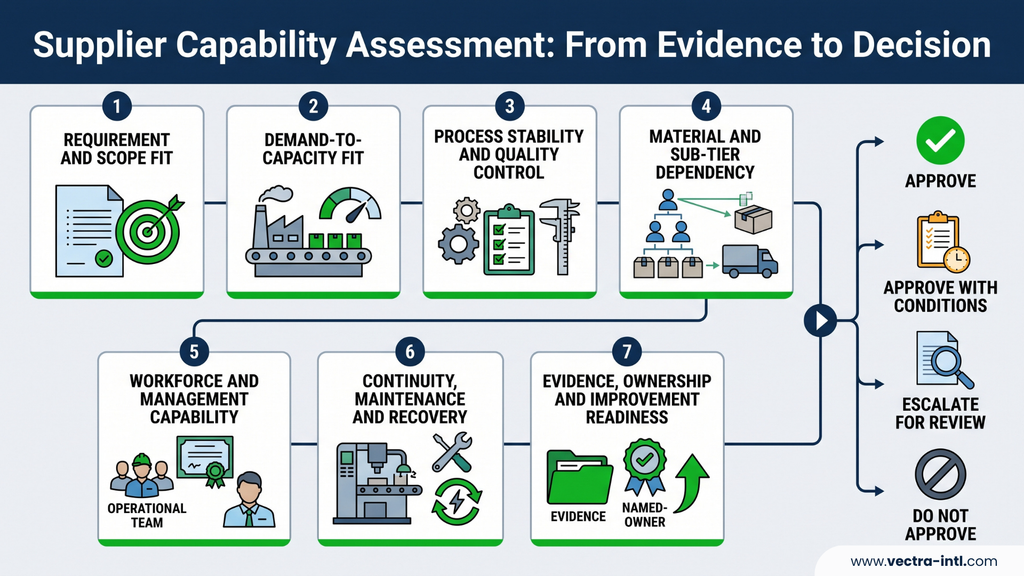
The 7 Supplier Capability Checks That Reveal Delivery Risk
Together, these seven areas form a practical supplier capability checklist for testing delivery readiness before approval.
1. Requirement and Scope Fit
Begin by translating the commercial request into an assessable operating scope. Define the products or services, specifications, volumes, delivery points, lead times, service levels, quality limits, regulatory conditions, and required records.
Then ask the supplier to show how its proposed operating model meets each requirement.
A weak response often begins with broad reassurance: “We already supply similar customers.” A stronger response maps each critical requirement to a process, owner, control, and record.
Pay particular attention to exclusions. If calibration, testing, labeling, transport, data hosting, or final inspection sits outside the supplier’s direct control, record who performs it and how performance is assured.
2. Demand-to-Capacity Fit
Stated capacity is not the same as usable capacity. A supplier may calculate output from machine speed and available hours while ignoring changeovers, maintenance, yield loss, labor shortages, queue time, or competing customer demand.
To evaluate the capacity model effectively, request evidence of demonstrated output by product family or process, along with available hours, shift patterns, and staffing assumptions. The review should also analyze changeovers, downtime, scrap, rework, yield data, and bottleneck constraints. Furthermore, examine allocation rules applied when demand exceeds supply, confirm available capacity for tooling, testing, packing, and dispatch, and verify the existence of a clear plan for managing peak volume or forecast errors.
A simple stress test is useful. Compare normal demand, expected peak demand, and a plausible disruption scenario. If the supplier can meet the forecast only when every assumption performs perfectly, the operating margin may be too narrow.
Do not reward a large headline number without checking the constraint behind it. The slowest or least flexible step often controls the actual delivery rate. In services, that constraint may be qualified people rather than equipment.
3. Process Stability and Quality Control
Capability depends on repeatability. A successful sample proves that an output can be achieved once. It does not prove that the process can achieve it consistently.
Review how the supplier controls variation from incoming material through final release.
Focus on the controls that prevent failure, not only the checks that detect it later. Final inspection can identify a defect, but it may not protect delivery if the entire batch must be reworked.
Where data are available, examine trends rather than a single month. Ask what changed when performance moved outside the target and whether the action prevented recurrence. A mature supplier should be able to explain both good and poor results without hiding normal operating variation.
4. Material and Sub-Tier Dependency
Many delivery failures begin below the direct supplier. A capable final assembly site may still depend on one constrained material, one specialist processor, or one unmonitored logistics route.
Identify the inputs that could stop or materially delay delivery. Review:
• critical raw materials, components, services, and data inputs;
• approved and actual sub-suppliers;
• single-source dependencies;
• country, transport, and regulatory exposure;
• supplier lead times and minimum order quantities;
• safety-stock assumptions and shelf-life limits;
• substitution and requalification requirements; and
• visibility over sub-tier changes.
The purpose is not to request a complete sub-tier map for every low-risk item. It is to understand the dependencies that matter to your scope and the controls used to manage them.
The OECD’s due diligence guidance for responsible business conduct also supports a risk-based approach to identifying and addressing impacts across business relationships. For capability decisions, the practical lesson is similar: direct-supplier confidence should not hide a critical dependency further upstream.
5. Workforce and Management Capability
Equipment and procedures do not operate themselves. Confirm whether the supplier has enough competent people to run, supervise, maintain, inspect, and improve the process.
Ask how new or temporary workers are qualified before they perform critical tasks. Check whether the supplier’s capacity plan assumes overtime or recruitment that has not yet occurred.
Management behavior also matters. Look for clear ownership, timely escalation, and evidence that leaders act on operational data. A supplier may have good procedures but weak follow-through when priorities compete.
6. Continuity, Maintenance, and Recovery
Capability should include the ability to recover, not only the ability to perform on a normal day.
Test the supplier’s response to a small number of credible disruptions. Depending on the scope, these may include equipment failure, utility loss, cyber incident, material shortage, quality hold, labor disruption, extreme weather, or transport interruption.
Review:
To assess continuity, maintenance, and recovery effectively, conduct a thorough review of the supplier’s preventive and predictive maintenance plans, as well as their provisions for critical spares and repair support. It is also essential to evaluate their backup equipment, sites, utilities, and data protocols, alongside their business continuity and incident-response plans. Furthermore, ensure you examine their definitions for maximum tolerable downtime and recovery assumptions, established communication and customer-notification rules, records of recent incidents and lessons learned, and the results of any exercises or tests performed on their recovery arrangements.
A continuity document is not enough. Ask when the plan was last tested, what failed during the test, and what changed afterward. Check whether backup arrangements can support the required specification and volume, not merely a reduced internal operation.
7. Evidence, Ownership, and Improvement Readiness
The final check asks whether the supplier can substantiate its claims and close gaps in a controlled way.
For each critical requirement, record the evidence reviewed, its date, its owner, and any limitation. Distinguish between:
• verified: current evidence directly supports the requirement;
• partially verified: some evidence exists, but the scope or period is incomplete;
• not verified: the claim has not been supported;
• not applicable: the requirement is outside the agreed scope.
If gaps remain, assess the supplier’s improvement readiness. A credible action should have a named owner, root cause, measurable output, due date, required resources, and a defined verification method. “Training will be provided” is not a complete plan. The plan should state who will be trained, on what requirement, by when, and how competence will be confirmed.
VECTRA’s guide to building an ESG gap analysis and pre-audit remediation plan offers a useful principle beyond ESG: convert every meaningful gap into an owned, prioritized action and verify closure with evidence.
What Evidence Should You Request?
Evidence should be recent, relevant to the proposed scope, and proportionate to risk. A practical request may include:
| Assessment area | Examples of useful evidence |
| Scope fit | Requirement review, feasibility record, specification acknowledgement, process route |
| Capacity | Demand and capacity model, bottleneck data, shift plan, demonstrated output |
| Process control | Control plan, yield and defect trends, calibration, maintenance, change records |
| Dependencies | Critical-input list, approved sub-suppliers, inventory policy, contingency arrangements |
| People | Competency matrix, training and authorization records, staffing and backup plan |
| Continuity | Recovery plan, exercise record, critical spares, incident and recovery evidence |
| Improvement | Gap register, corrective-action plan, owner and due date, closure verification |
Avoid requesting documents simply because they appear on a standard questionnaire. Every item should help confirm a requirement, test an assumption, or resolve an uncertainty.
Where sensitive information is involved, agree how it will be protected and whether a summary, controlled review, or independent verification is sufficient.
How Should You Score the Result?
Scoring can improve consistency, but false precision can obscure the decision. A supplier with an average score of 82 percent may still have one unresolved failure mode that can stop delivery.
Use two layers:
1. Record evidence status for each requirement: verified, partial, missing, or not applicable.
2. Apply decision rules to critical gaps: approve, approve with conditions, escalate, or do not approve.
Weight requirements only when the weights reflect real business impact. Identify non-negotiable criteria separately. For example, a missing backup plan may be manageable for a replaceable catalog item but unacceptable for a sole-source part with a six-month requalification period.
Document the rationale. The record should show what was accepted, what remains open, who accepted it, and when the decision must be reviewed.
A Practical 30-Day Assessment Workflow
Days 1–5: Define the Decision
Confirm scope, stakeholders, approval criteria, critical requirements, and evidence boundaries. Assign one assessment owner and involve procurement, quality, operations, compliance, engineering, or IT where relevant.
Days 6–10: Collect Focused Evidence
Send a requirement-based request. Ask the supplier to identify owners and explain evidence, rather than uploading an unstructured archive.
Days 11–15: Test Assumptions
Compare demand with demonstrated capacity. Trace a sample requirement through process controls. Examine a recent disruption, change, defect, or late delivery. Clarify critical sub-tier dependencies.
Days 16–20: Validate Critical Points
Use interviews, remote review, data checks, or an on-site visit where uncertainty and impact justify it. Resolve contradictions between documents, data, and operational explanations.
Days 21–25: Classify Gaps
Separate immediate approval blockers from controlled conditions and longer-term improvements. Agree the evidence needed to close each gap.
Days 26–30: Decide and Govern
Record the approval decision, limitations, owners, due dates, monitoring measures, and review triggers. Build conditions into the commercial and operating relationship where appropriate.
The work does not end at approval. Early delivery data should test whether the assessment assumptions were correct. Review the decision after launch, a major volume change, or a significant incident.
In Brief
A supplier capability assessment is a decision tool, not a document-collection exercise. It begins with a defined delivery requirement and tests whether the supplier’s operating system can meet it consistently.
The seven checks cover scope fit, capacity, process stability, dependencies, people, continuity, and improvement readiness. Together, they reveal risks that certificates, samples, or commercial claims may miss.
The output should be a clear approval decision with evidence, conditions, ownership, and review triggers. If the assessment identifies material capability gaps, VECTRA’s Factory, Farm & Mine Performance Improvement support can help turn those findings into practical, measurable site-level actions.
Frequently Asked Questions
What is the main purpose of a supplier capability assessment?
Its purpose is to determine whether a supplier can meet a defined operational requirement consistently. It supports an approval, conditional approval, escalation, or rejection decision using evidence about capacity, process control, people, dependencies, continuity, and improvement readiness.
Is supplier capability the same as supplier performance?
No. Capability concerns whether the supplier’s operating system can meet the requirement. Performance concerns the results the supplier has already delivered. Historical performance is useful evidence, but a new product, higher volume, different site, or changed specification can create a new capability question.
Does every supplier need an on-site capability assessment?
No. The assessment method should reflect the impact and uncertainty of the decision. A focused desktop review may be enough for a low-risk, replaceable purchase. A critical or sole-source scope may require interviews, detailed data, process observation, or on-site validation.
Which supplier capability KPIs should you track?
Useful measures may include demonstrated capacity, on-time delivery, first-pass yield, defect rate, scrap, rework, unplanned downtime, changeover time, maintenance completion, staffing coverage, corrective-action closure, and recovery time. Select KPIs that test the proposed scope rather than using a generic scorecard.
What should happen when the supplier has a capability gap?
Classify the gap by business impact. Define the action, owner, due date, required evidence, and verification method. Decide whether approval can proceed with conditions or must wait. Critical gaps should not disappear inside an average score.
How often should supplier capability be reassessed?
Reassess when the scope or risk changes, such as a volume increase, new site, product change, sub-supplier change, repeated failure, major disruption, or contract renewal. For critical suppliers, define periodic review triggers and use live performance data to test the original assumptions.
View Related Posts
• Responsible Purchasing Practices: How Procurement Decisions Shape Supplier Performance
• Supplier Improvement Roadmap: From Findings to Sustainable Performance
• FMCG Sustainability Data: From Supplier Requests to Decision-Ready Evidence
VECTRA International is a trusted Business Resilience & Operational Capability Building Partner. Through our ecosystem of integrated solutions, we help organizations transform operational complexity into resilient performance, measurable business impact, and sustainable growth.
Chaussée de Wavre 1517B, 1160 Brussels, Belgium.
A Note on Our Visuals: At VECTRA, we combine human expertise with advanced technology. Some of the supportive imagery in this article was generated using artificial intelligence tools like Google Gemini. We ensure all conceptual AI assets align with our brand standards and accurately reflect our data.