A supplier improvement roadmap turns an audit finding into a clear sequence of owned actions, supplier support, evidence and performance checks. It does more than close a corrective action. It shows what must change, who will change it, when the result will be tested and what happens if performance does not improve.
That distinction matters because an audit report is a snapshot. Supplier performance improvement happens after the report, when procurement, operations, quality and the supplier work through the causes together. Without that operating rhythm, the same finding often returns under a new date.
In one sentence: A corrective action closes a finding; a supplier improvement roadmap builds the capability and control needed to stop it returning.
What is a supplier improvement roadmap?
A supplier improvement roadmap is a time-bound plan for moving a supplier from a verified performance gap to an agreed target. It connects audit findings, root causes, corrective actions, capability support, owners, milestones, evidence and outcome metrics in one place.
This fits the six-step due diligence model in the OECD Due Diligence Guidance for Responsible Business Conduct: identify and assess impacts, prevent or mitigate them, track implementation and results, communicate what happened and provide or support remediation where appropriate. A roadmap makes those steps operational at supplier level.
Why do audit findings keep returning?
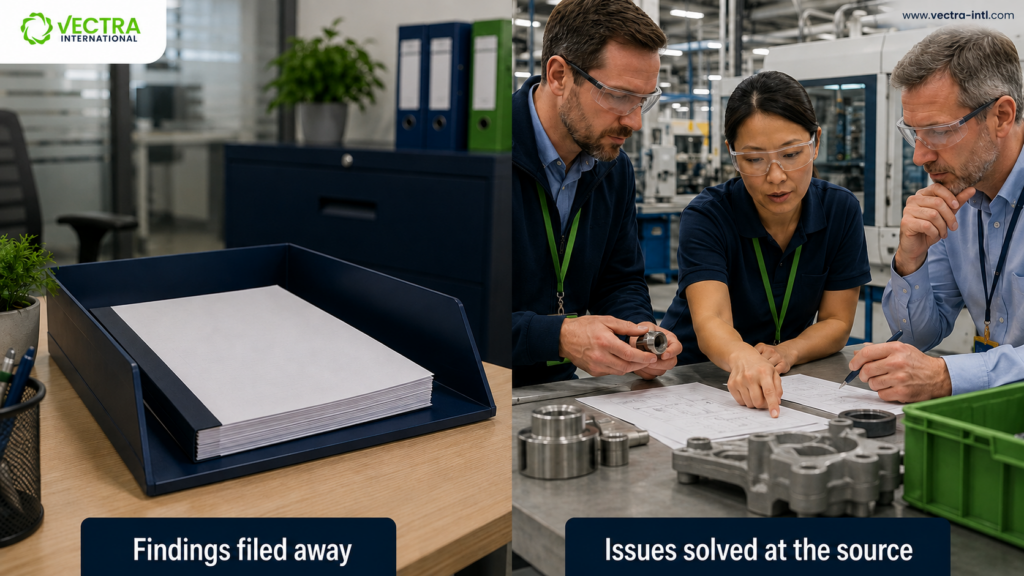
Repeat findings are rarely caused by a missing spreadsheet. They usually return because the response fixed the visible symptom but left the management-system gap untouched.
- The action describes an activity, such as ‘retrain workers’, but not the behavior or result that must change.
- A department is listed as the owner, so no named person is accountable for delivery.
- The supplier is asked to improve without enough time, technical support, stable forecasts or commercially workable purchasing terms.
- Closure is accepted when a document is uploaded, even though no one checks whether the fix works in practice.
- Every supplier receives the same response, regardless of risk, importance, capability or willingness to improve.
The OECD Responsible Business Outlook 2026 describes a broader version of this problem. Across the largest 10,000 listed companies, commitments and management systems were common, but an implementation gap remained between policy and practice. The practical lesson is simple: documented intent is not the same as controlled execution.
Corrective action plan vs supplier improvement roadmap
| Question | Corrective action plan | Supplier improvement roadmap |
| Primary job | Resolve a defined non-conformance. | Improve the system and the resulting supplier performance. |
| Typical scope | One finding or audit cycle. | Connected findings, capability gaps and business outcomes. |
| Measures | Action completed and evidence submitted. | Finding closed, fixes verified and performance sustained. |
| Support | Often supplier-led. | Buyer and supplier agree the support, resources and decision rights required. |
| End point | Closure accepted. | Outcome achieved, sustained and built into normal management. |
Corrective action plans still matter. Sedex explains that SMETA audits use corrective action plans to resolve audit issues and improve supplier performance. The roadmap does not replace that plan. It extends it when the issue is systemic, repeated or commercially important. For more on the corrective-action layer itself, read VECTRA’s article on post-audit corrective action plans.
How to build a supplier improvement roadmap in seven steps
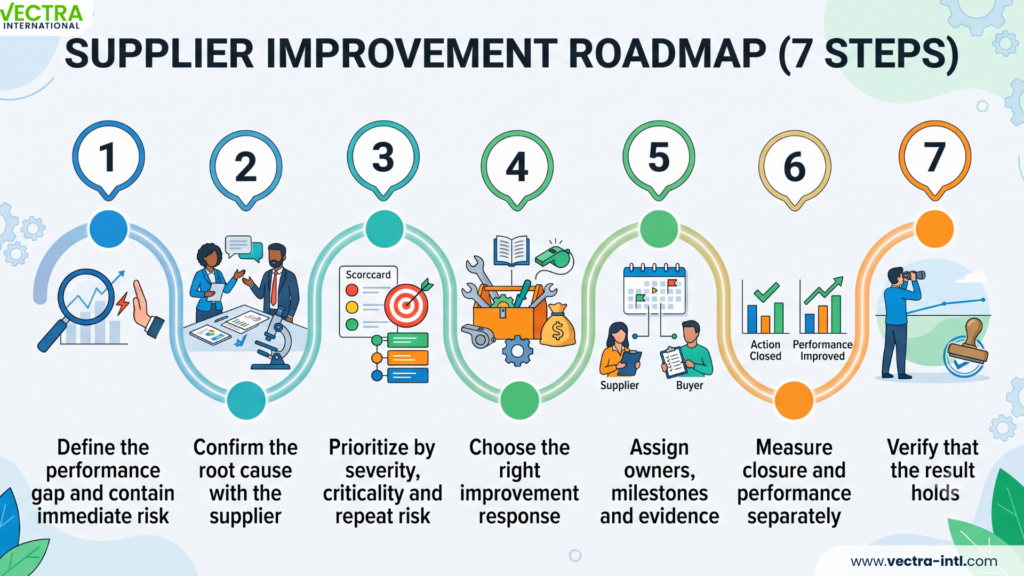
1. Define the performance gap and contain immediate risk
Start with a factual baseline. State the failed requirement, the current result, the target and the business effect. If workers, customers, product quality or delivery are at immediate risk, contain that risk before starting longer-term improvement work.
2. Confirm the root cause with the supplier
Do not write the plan from the buyer’s desk alone. Use records, interviews, process observation and performance data to distinguish a one-off lapse from a weak process, skill gap, resource constraint or buyer-created pressure. An OECD garment-sector procurement pilot found that discussing possible remedies with suppliers was more effective than demanding action unilaterally.
3. Prioritize by severity, criticality and repeat risk
Not every finding needs a twelve-month programme. Score the issue by impact severity, likelihood of recurrence, supplier criticality and strength of existing controls. Fix urgent harm first, then concentrate deeper support where failure would affect customers, continuity, market access or people.
4. Choose the right improvement response
Training is useful for a real knowledge or skill gap. Coaching helps a team apply new behavior. Process redesign is needed when handoffs or ownership are broken. Equipment, finance, data or technology support may be necessary where capability is constrained by resources. Match the intervention to the cause.
5. Assign owners, milestones and evidence
Give each action a named supplier owner and a named buyer-side owner. Define the due date, interim milestone, resource needed, evidence required and escalation route. A roadmap with no buyer-side owner quietly becomes a supplier wish list.
6. Measure closure and performance separately
First confirm that the action was completed. Then test whether it changed the outcome. A revised procedure proves that a document changed; it does not prove that defects fell, wages were calculated correctly or orders arrived on time.
7. Verify that the result holds
Review evidence after enough operating time has passed. Use a follow-up visit, sample check, worker feedback, transaction data or a focused re-audit. Then close, extend, escalate or, where improvement is not possible, consider responsible disengagement as a last resort.
What should the supplier improvement roadmap contain?
| Finding and cause | Action and support | Ownership and timing | Evidence and outcome |
| Repeat late deliveries caused by unstable production planning. | Weekly capacity plan, forecast review and planner coaching. | Supplier planning lead; buyer planner; 90-day review. | Approved plan; schedule adherence; on-time-in-full trend. |
| Payroll errors caused by manual calculation and weak review. | Control redesign, payroll training and monthly sample checks. | Supplier HR lead; buyer social-compliance lead; 60 days. | Correct payslips; exception log; reduced repeat errors. |
| Incomplete traceability evidence caused by unclear data ownership. | Map data owners, standardize records and test one product flow. | Supplier operations lead; buyer traceability lead; 12 weeks. | Complete evidence chain; fewer rejected records. |
Which supplier performance metrics matter?
Use a small set of measures that show both execution and business effect. The right mix depends on the issue, but useful categories include:
- Control metrics: actions on time, overdue actions, evidence accepted first time and verification completed.
- Quality metrics: defect rate, rework, returns, complaints and repeat non-conformances.
- Delivery metrics: on-time-in-full delivery, schedule adherence, lead-time variation and premium freight.
- Responsible-business metrics: recurrence of labour, safety or environmental findings; grievance resolution; and worker or stakeholder feedback.
- Capability metrics: application of new skills, process adherence, management review quality and improvement ideas sustained after support ends.
Avoid turning the roadmap into another dashboard. A metric earns its place only if it changes a decision: continue support, adjust the action, escalate the issue or recognise sustained improvement.
The buyer is part of the improvement system
Supplier performance can be weakened by the buyer’s own forecasts, prices, lead times, order changes and payment practices. If the root cause sits upstream, demanding faster improvement from the supplier will not solve it. Review VECTRA’s seven responsible purchasing decisions that shape supplier performance alongside the supplier roadmap.
From audit finding to controlled improvement
A supplier improvement roadmap works when it gives both sides control: a shared baseline, a manageable set of priorities, named owners, practical support and evidence that the result holds. That is how an audit becomes an improvement process instead of an annual reminder.
VECTRA supports that journey from rapid diagnosis to in-depth evidence review and collaborative implementation. If you need help turning supplier findings into a workable roadmap, explore VECTRA’s Factory, Farm & Mine Performance Improvement support or start with Audit Assistance.
Frequently Asked Questions
What is a supplier performance improvement plan?
It is a structured plan for moving a supplier from a defined performance gap to an agreed target. A strong plan includes root cause, actions, support, owners, milestones, evidence, outcome metrics and escalation rules.
How is a supplier improvement roadmap different from a corrective action plan?
A corrective action plan normally resolves a specific non-conformance. A supplier improvement roadmap connects several actions to the wider capability, process and performance change needed to prevent recurrence.
Who should own supplier improvement?
The supplier should own changes within its operation, while the buyer assigns a named owner to provide decisions, data, support and escalation. Procurement often coordinates, but quality, operations, compliance, finance and planning may each own part of the result.
How long should a supplier improvement roadmap take?
It depends on severity and root cause. Immediate containment may take days, a process correction may take 30 to 90 days, and a deeper management-system or capability change may require several operating cycles.
How do you know whether corrective action was effective?
Check both evidence and outcome. Confirm the action happened, then test whether the original issue stopped recurring and the relevant performance measure improved over a meaningful period.
View Related Posts
How Post-Audit Corrective Action Plans Drive Continuous ESG Performance
ESG Supply Chain Audits: A Guide for Procurement Leaders
VECTRA International is a trusted Business Resilience & Operational Capability Building Partner. Through our ecosystem of integrated solutions, we help organizations transform operational complexity into resilient performance, measurable business impact, and sustainable growth.
Chaussée de Wavre 1517B, 1160 Brussels, Belgium.
A Note on Our Visuals: At VECTRA, we combine human expertise with advanced technology. Some of the supportive imagery in this article was generated using artificial intelligence tools like Google Gemini. We ensure all conceptual AI assets align with our brand standards and accurately reflect our data.