Summary
ESG audit and assurance services for supply chains are now a critical requirement for regulatory compliance, risk management, and ESG maturity. This guide explores the full lifecycle of ESG supply chain auditing—from scope definition and data verification to corrective action and digital transformation.
It also highlights key regulatory frameworks like CSRD and ESRS, emerging best practices, and how VECTRA International’s environmental and social maturity tools deliver actionable insights to procurement and sustainability teams seeking scalable, audit-ready ESG solutions.
Introduction
The sustainability-centric marketplace of 2025 is making procurement leaders go beyond cost and delivery metrics. ESG audit and assurance services for supply chains are essential tools to ensure supply chain transparency, resilience, and compliance.
With regulations like CSRD, ESRS, and buyer expectations growing, mastering ESG supply chain audit services is indispensable.
What Are ESG Supply Chain Audits & Why They Matter
ESG audit and assurance services for supply chains are no longer optional—they’re a strategic imperative. As global expectations around transparency and responsible sourcing rise, procurement leaders are turning to structured ESG supply chain audit services to assess supplier practices across environmental, social, and governance (ESG) criteria.
At the core of this transformation:
- Supply chain sustainability assurance ensures suppliers meet critical environmental and labor standards—validating alignment with regulatory and voluntary frameworks.
- Third-party ESG supply chain verification provides independent, objective assurance that builds trust, enhances reporting credibility, and reduces reputational and legal exposure.
Procurement teams that integrate ESG supplier assessments into their operations are better positioned to proactively manage Scope 3 emissions, avoid regulatory fines, and meet rising investor expectations.
A robust ESG supply chain due diligence program empowers organizations to transform procurement from a reactive function into a forward-looking, risk-aware driver of sustainable performance.
The ESG Supply Chain Audit Process — From Scope to Corrective Action
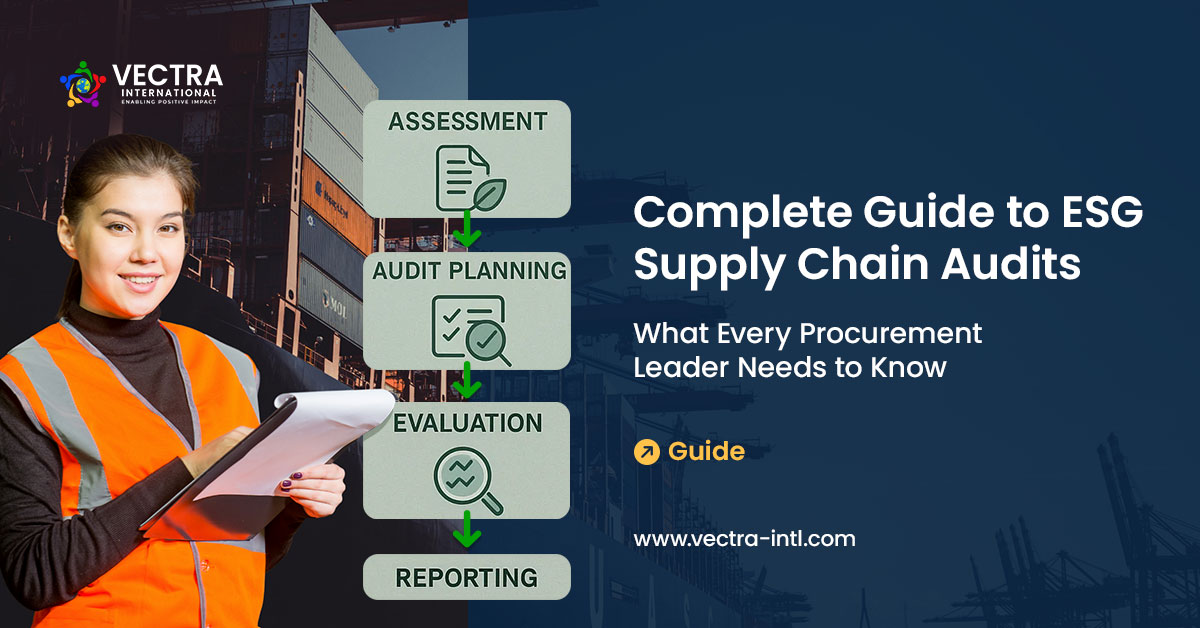
Effective ESG audit and assurance services for supply chains require a structured, end-to-end process that delivers both credibility and actionable insights. Here’s how leading procurement teams implement ESG supply chain audits that drive accountability and performance:
1. Define Audit Scope and Criteria
Start with a clearly defined scope covering Scope 3 emissions, labor practices, and governance compliance across all supplier tiers (1–3). This ensures alignment with global sustainability reporting expectations and mitigates risk deep into the supply chain.
2. Select ESG Audit Frameworks
Use relevant frameworks and metrics such as Supplier ESG compliance monitoring, ESRS-aligned supply chain data verification, and carbon footprint assessments that comply with CSRD, GRI, and other regulatory standards.
3. Leverage Digital Audit Tools
Adopt digital platforms for structured ESG data collection, KPI tracking, and workflow automation—critical for scaling ESG supply chain due diligence services efficiently and consistently.
4. Conduct On-Site and Third-Party Verification
Field audits remain a vital part of third-party ESG supply chain verification, especially for validating emissions data and assessing adherence to human rights standards.
5. Formalize Reporting and Assurance
Translate findings into audit-ready documentation and formal disclosures to support ESG supply chain reporting verification and investor-grade assurance.
6. Implement Corrective Actions and Monitoring
Use audit outcomes to drive supplier improvements with ongoing monitoring systems that embed ESG into the procurement lifecycle.
Core Metrics for ESG Supply Chain Audits
| Category | Key KPIs |
| Environmental | Scope 3 emissions, supplier water footprint, waste/recycling, renewable energy use |
| Social | Labor standards, health & safety protocols, diversity & inclusion, community investment |
| Governance | Supplier ethics & compliance systems, audit resolution speed, traceability, certifications |
In-depth metrics like ESG supply chain KPI verification and Supplier sustainability performance auditing form the baseline for structured assurance.
Regulatory Drivers & Assurance Expectations in ESG Supply Chain Audits
As ESG regulations tighten globally, procurement leaders must align audit practices with mandatory disclosure and assurance frameworks. Key drivers shaping ESG audit and assurance services for supply chains include:
CSRD Supply Chain Assurance Requirements
Under the EU’s Corporate Sustainability Reporting Directive (CSRD), companies must undergo external assurance of supply chain disclosures—especially concerning Scope 3 emissions and social risks. Procurement teams are expected to deliver audit-ready documentation that withstands third-party scrutiny.
ESRS Supply Chain Data Verification
The European Sustainability Reporting Standards (ESRS) require granular environmental and social data from across the supply chain. These standards call for independently verified emissions reporting, labor rights assessments, and governance transparency, all to be disclosed starting 2025.
Enforcement Through ESG Compliance Audits
ESG supply chain compliance is no longer optional. Regulatory enforcement is increasing, and large buyers now mandate ESG compliance audits as part of procurement contracts. Failure to provide verified data may lead to lost business, regulatory penalties, or reputational damage.
To remain competitive, organizations must integrate terms like Supply Chain ESG Certification Audit into sourcing protocols and supplier documentation—ensuring regulatory alignment and ESG visibility across the value chain.
Key Risks Mitigated by ESG Audit and Assurance Services for Supply Chains
Comprehensive ESG supply chain audit services do more than tick compliance boxes—they proactively safeguard against high-impact operational and reputational risks. Strategic audit programs help procurement leaders build resilient, transparent, and responsible supply chains.
1. Scope 3 Emissions Hotspots Identification
Through a structured Scope 3 emissions supply chain audit, organizations can map emissions intensity across supplier tiers. This enables data-driven decarbonization strategies and aligns with CSRD reporting mandates.
2. Enhanced Transparency and Traceability
A supply chain transparency audit brings visibility into upstream operations, surfacing material risks and enabling better decision-making across ESG metrics.
3. Verified Carbon Reporting Accuracy
Supplier GHG emissions verification improves the integrity of carbon disclosures—helping organizations meet investor expectations and avoid greenwashing claims.
4. Social and Operational Risk Detection
Audits uncover early signs of labor violations, fraud, or supply chain disruptions. According to Deloitte, proactive ESG auditing significantly reduces reputational exposure and supports long-term supply continuity.
Digital Transformation in ESG Audit and Assurance Services for Supply Chains
Modern ESG supply chain audit services are being redefined by digital innovation. Traditional, labor-intensive assessments are being replaced by scalable, intelligent systems that deliver speed, accuracy, and actionable insights.
1. Digital ESG Auditing Platforms
Purpose-built platforms simplify and centralize audit workflows—enabling seamless data collection, documentation, and risk profiling across complex, multi-tiered supply chains.
2. Automated ESG Supplier Assessments
AI-powered tools automate supplier scoring, identify red flags, and benchmark ESG performance. This enhances the precision and repeatability of ESG supplier assessments, even at scale.
3. Real-Time Monitoring Systems
Next-generation ESG supply chain monitoring systems provide continuous oversight with real-time alerts, enabling procurement teams to react swiftly to compliance deviations or operational risks.
Implementing a Supply Chain ESG Due Diligence Checklist
Establishing a structured due diligence process is essential for embedding ESG audit and assurance services into supply chain operations. A comprehensive ESG checklist serves as both a compliance safeguard and a performance optimization tool.
Core Elements of a High-Impact ESG Supply Chain Due Diligence Checklist:
- Supplier Sustainability Performance
Confirm third-party certifications (e.g., ISO 14001), evaluate environmental policies, and validate GHG emissions disclosures across all supplier tiers.
- Labor & Human Rights Screening
Assess worker safety standards, grievance mechanisms, and supply chain labor practices in line with global frameworks such as the UNGPs and ILO conventions.
- Environmental Compliance
Review supplier climate adaptation strategies, pollution control systems, and resource efficiency initiatives to mitigate environmental risk.
- Governance Standards
Evaluate ethics codes, anti-corruption policies, whistleblower protection mechanisms, and contract governance protocols.
VECTRA International’s ESG Supply Chain Audit Solutions
VECTRA International delivers precision-driven ESG audit and assurance services for supply chains—equipping procurement and sustainability leaders with the tools to ensure compliance, uncover risk, and drive supplier transformation.
1. Environmental Maturity Assessment
Designed to support supply chain carbon footprint verification and Scope 3 emissions auditing, this assessment evaluates environmental practices across all supplier tiers. It assesses carbon reporting readiness, decarbonization progress, and alignment with international environmental standards—forming the foundation for robust supply chain decarbonization audits.
2. Social Maturity Assessment
Co-developed by VECTRA International and Ethisphere, this assessment delivers a deep dive into labor conditions, safety protocols, diversity and inclusion, and human rights alignment. It is instrumental in ESG supplier compliance monitoring, providing organizations with actionable insights to improve workforce welfare and ensure alignment with global social governance norms.
Together, these modular tools enable procurement leaders to build ESG maturity into their sourcing strategies—combining regulatory compliance, stakeholder assurance, and operational resilience in one integrated solution.
Conclusion
As ESG standards tighten globally, supply chain audit and assurance services have become essential for procurement leaders tasked with mitigating risk, ensuring compliance, and delivering on sustainability goals. The complexity of Scope 3 emissions, labor compliance, and supplier governance demands more than ad hoc assessments—it calls for a strategic, digitally enabled approach to ESG due diligence.
By embedding ESG audit processes into procurement workflows, organizations can improve data transparency, meet stakeholder expectations, and safeguard business continuity. Digital platforms, third-party verifications, and structured checklists help scale efforts across multi-tiered supplier networks.
VECTRA International enables businesses to move from reactive compliance to proactive ESG leadership through purpose-built tools like the Environmental and Social Maturity Assessment platforms. With our expertise, procurement becomes a powerful engine for sustainability transformation—equipped to navigate evolving regulations and build trust in every supply chain link.
Let’s build responsible supply chains—backed by audit-ready ESG intelligence.