A supplier risk assessment checklist should help you make a decision, not simply collect supplier information. It should identify what could go wrong, test the evidence behind each answer, distinguish inherent risk from the controls already in place, and place each supplier into a risk tier with a clear next action.
That result matters because suppliers do not create equal exposure. A low-spend supplier can still be critical if it handles personal data, supplies a regulated material, controls a single-source component, or operates in a high-risk location. A high-spend supplier may be replaceable and tightly controlled. Spend is a useful context, but it is not a complete risk model.
The practical aim is to answer four questions:
• How important is this supplier to the business?
• What operational, financial, compliance, environmental, social, and governance risks are present?
• Which controls and evidence reduce those risks?
• What decision, action, or level of oversight is justified?
What Is a Supplier Risk Assessment Checklist?
A supplier risk assessment checklist is a structured set of questions and evidence tests used to identify, evaluate, and prioritize risks connected to a supplier relationship. It helps procurement, compliance, operations, quality, sustainability, finance, legal, and information-security teams use the same criteria before approval and during material changes.
The checklist is only one part of the assessment. The complete process should include:
1. a defined business decision and scope;
2. supplier segmentation and criticality;
3. risk questions that match the goods, services, locations, and data involved;
4. evidence review and validation;
5. inherent and residual risk scoring;
6. decision rules and escalation thresholds; and
7. an owned action and monitoring plan.
Without those elements, the exercise can become a long questionnaire with no reliable conclusion. A supplier may answer every question, yet the organization may still not know which claim was verified, which gap is material, or whether approval should proceed.
The assessment should also begin from an agreed current state. VECTRA’s explanation of baseline assessment versus readiness assessment shows why that distinction matters. A baseline records what is true now. A readiness test asks whether that evidence is sufficient for a defined decision, requirement, or event. A strong supplier risk assessment uses both ideas.
What Decision Should the Assessment Support?
Define the decision before sending the questionnaire. Otherwise, teams tend to request every document they can imagine and then struggle to interpret the response.
Common decisions include:
• approve the supplier for the proposed scope;
• approve with conditions and enhanced oversight;
• limit approval to a product, site, country, volume, or period;
• request deeper due diligence or an on-site assessment;
• pause onboarding until a critical gap is closed; or
• reject the supplier because the remaining risk is outside tolerance.
The decision must be tied to the actual relationship. State which legal entity, site, product or service, delivery route, information access, and sub-tier dependencies are included. Record exclusions and assumptions. A group-level policy does not automatically prove that one production site has implemented the required control.
The assessment owner should also name the reviewers who can judge different evidence. Procurement may understand commercial dependency. Quality may test production and release controls. Information security may evaluate access to systems and data. Sustainability or human-rights specialists may need to review labor and community impacts. One person can coordinate the decision without pretending to be the expert in every risk domain.
How Are Supplier Risk, Criticality, and Capability Different?
Supplier risk, criticality, and capability are connected, but they are not interchangeable.
| Concept | Core question | Typical evidence | Main output |
| Supplier criticality | How serious would the effect be if this supplier failed or became unavailable? | spend, substitutability, lead time, customer impact, data access, regulatory importance | criticality tier |
| Supplier risk | What events or conditions could harm objectives, people, compliance, continuity, or reputation? | ownership, location, financial, compliance, ESG, cyber, operational, and sub-tier evidence | inherent and residual risk rating |
| Supplier capability | Can the supplier meet the defined volume, quality, cost, and delivery requirement consistently? | capacity, process control, workforce, maintenance, continuity, and performance data | approval decision for the proposed scope |
VECTRA’s supplier capability assessment examines whether a supplier can deliver the proposed requirement. This checklist takes a wider risk view. A supplier may be capable of producing the item but still create unacceptable sanctions, labor, cyber, financial, or concentration exposure. The reverse is also possible: a supplier may present low legal and ESG risk but lack the capacity or process stability needed for the contract.
Treat criticality as an exposure multiplier, not as proof that the supplier is risky. A critical supplier with strong controls may remain a high-priority relationship because the consequence of failure is severe. A noncritical supplier with poor integrity evidence may still require rejection, even if replacement is easy.
Which Suppliers Should You Assess First?
Do not begin by sending the full checklist to every supplier. Start with a short segmentation screen that identifies where a deeper assessment is justified.
Use information already available in contracts, procurement systems, site records, data inventories, audit reports, and supplier master data. Segment suppliers using factors such as:
• business interruption impact;
• single-source or limited-source dependency;
• time and cost required to switch;
• safety, quality, or regulatory significance;
• access to confidential, personal, or operational data;
• use of subcontractors or labor intermediaries;
• country and sector exposure;
• proximity to workers, communities, or natural resources;
• value and duration of the relationship; and
• past incidents, audit findings, or repeated failures.
This first screen should determine assessment depth. A standard office-supply purchase may need basic identity, sanctions, privacy, and continuity checks. A sole-source component, recruitment agency, cloud provider, or raw-material supplier may need specialists, site-level evidence, interviews, and independent validation.
The principle is proportionate effort. The ISO 31000 risk management guidelines describe a structured process for identifying, analyzing, evaluating, treating, monitoring, and communicating risk. Applied to suppliers, that means the method should reflect the context and consequence of the decision rather than treating every third party alike.
The Supplier Risk Assessment Checklist
The following ten areas create a practical starting point. For every material answer, record the evidence reviewed, its scope, date, owner, and limitations.
1. Identity, Ownership, and Integrity
Confirm the contracting entity, operating sites, beneficial ownership, directors, and authorized representatives. Check whether names and addresses are consistent across contracts, registrations, invoices, bank details, certificates, and public records.
Assess sanctions, debarment, conflicts of interest, bribery and corruption controls, adverse media, litigation, and significant regulatory action where relevant and lawful. A screening result should not be treated as a verdict on its own. Resolve likely matches, document false positives, and escalate material uncertainty.
Useful evidence can include corporate registrations, ownership declarations, tax information, codes of conduct, conflict disclosures, investigation procedures, training records, and validated screening results.
2. Financial Stability and Commercial Dependency
Assess whether the supplier can finance the proposed work and withstand plausible stress. Review current financial information, cash constraints, insurance, payment behavior, credit indicators, major customer concentration, commodity exposure, and reliance on one contract or lender where available.
Look in both directions. A supplier that depends heavily on your business may accept unrealistic terms to win the contract. A buyer that depends on one supplier may have little leverage during disruption. Record the commercial assumptions that could change the rating, including prices, payment terms, volume forecasts, and planned capital investment.
3. Operational Resilience and Continuity
Identify processes, equipment, utilities, people, logistics routes, and sites that could interrupt delivery. Review business-continuity and incident-response plans, but also ask when they were tested and what changed afterward.
Consider capacity constraints, maintenance, critical spares, alternate sites, recovery time, inventory assumptions, extreme weather, energy reliability, transport dependency, and customer-notification rules. If the assessment exposes uncertainty about actual delivery capability, use the more focused supplier capability assessment rather than stretching this checklist beyond its purpose.
4. Quality, Product Safety, and Regulatory Control
Confirm the standards, specifications, licenses, approvals, testing, release controls, and traceability requirements that apply to the supplied product or service. Review certification scope and expiry dates. A valid certificate may support the assessment, but it does not prove that every relevant process, product, or location is controlled.
Examine complaint history, recalls, defects, change control, calibration, corrective actions, and regulatory findings. Test whether responsibilities remain clear when work is outsourced. For critical products, independent sampling or validation may be justified.
5. Legal and Trade Compliance
Map the laws and contractual obligations that affect the relationship. Depending on scope, this may include sanctions, export controls, customs, product compliance, competition, anti-bribery, modern-slavery, environmental, employment, privacy, and sector-specific requirements.
Ask the supplier to show how requirements are translated into controls, ownership, training, approvals, and records. A generic statement that the business complies with all laws is not evidence of implementation. Record which requirements were tested and which remain outside the assessment.
6. Human Rights and Labor Conditions
Identify actual and potential impacts on workers and communities, including forced labor, child labor, recruitment fees, discrimination, harassment, working time, wages, health and safety, freedom of association, land, security practices, and access to remedy.
Risk to people is not the same as financial or reputational risk to the buyer. Where human-rights impacts are material, apply a dedicated human rights due diligence process and prioritize the most severe impacts. The OECD Due Diligence Guidance for Responsible Business Conduct provides a risk-based framework for responsible business conduct across operations, supply chains, and business relationships.
7. Environmental and Climate Exposure
Consider legal permits, emissions, water, waste, hazardous materials, biodiversity, land use, deforestation, energy, and climate-related disruption where they are relevant to the supplier and product.
Check whether the supplier can trace environmental claims to site-level or product-level evidence. Identify dependencies that could affect continuity or compliance, such as water scarcity, flood exposure, constrained materials, or an unpermitted waste contractor. Avoid awarding a high score because a policy exists if operating data and corrective actions are missing.
8. Information Security and Data Protection
Determine what systems, facilities, data, credentials, intellectual property, or operational technology the supplier can access. Assess data location, subcontractors, security governance, access control, encryption, backup, incident notification, vulnerability management, and recovery arrangements.
The depth should reflect access and consequence. A supplier processing personal data or connecting to production systems needs a different review from a supplier receiving only public purchase orders. Coordinate with privacy, legal, and security teams so the checklist does not create unsupported technical judgments.
9. Sub-Tier, Geographic, and Concentration Risk
Identify the subcontractors, labor providers, critical materials, and logistics partners that matter to delivery or responsible-business outcomes. Ask whether the supplier can name them, monitor changes, and explain how performance and compliance are controlled.
Assess concentration by site, country, route, material, technology, and sub-supplier. A direct supplier may appear diversified while several approved sites depend on the same upstream source. Where visibility is incomplete, score the uncertainty rather than assuming no risk exists.
10. Governance, Evidence, and Improvement Capacity
Check whether risks have named owners, management oversight, reporting routes, investigation processes, and protected grievance or speak-up channels. Review whether the supplier records incidents, analyzes root causes, completes corrective actions, and verifies effectiveness.
VECTRA’s guide to ESG maturity assessment explains why policy, process, data, and results must be evaluated together. A supplier with an incomplete system but transparent ownership and credible improvement capacity may be manageable under conditions. A supplier that withholds evidence, changes its explanation, or refuses reasonable corrective action creates a different decision.
What Evidence Should Support the Checklist?
Good evidence is relevant, current, traceable, and appropriate to the question. It can include records, datasets, interviews, observations, independent reports, samples, and tested controls. The strongest evidence is not always the longest document.
Classify each item consistently:
• Verified: current evidence directly supports the answer and covers the assessed scope.
• Partially verified: evidence exists, but its site, period, product, or control coverage is incomplete.
• Unverified: the claim has not been supported or conflicting information remains unresolved.
• Not applicable: the requirement does not apply to the defined relationship, with the reason recorded.
Do not score missing evidence as good performance. “No incidents reported” is not equivalent to evidence that incidents are identified, recorded, investigated, and closed. Equally, missing documentation does not always prove poor operating performance. It does mean the conclusion is uncertain, and that uncertainty should affect the decision.
The ESG gap analysis and pre-audit remediation plan provides a useful method for converting evidence gaps into owned actions. Apply the same discipline here: state the gap, consequence, owner, deadline, required completion evidence, and verification method.
How Should You Score Supplier Risk?
Use a scoring method that people can explain without a spreadsheet. A five-point scale is usually sufficient when every level has a clear definition.
First, score inherent risk before considering supplier controls:
| Score | Likelihood | Impact |
| 1 | rare under credible conditions | limited, recoverable effect |
| 2 | unlikely but plausible | contained effect with routine response |
| 3 | possible | material operational, financial, compliance, environmental, or social effect |
| 4 | likely | serious or sustained effect requiring senior intervention |
| 5 | expected, recurring, or already occurring | severe, widespread, difficult-to-remedy, or business-critical effect |
You can calculate a simple inherent score by multiplying likelihood by impact. A 1 to 5 result is low, 6 to 10 is moderate, 11 to 15 is high, and 16 to 25 is very high. These bands are examples, not universal standards. Adjust them to your risk appetite and test them against real supplier cases before use.
Second, rate control effectiveness using evidence:
| Control rating | Meaning |
| Strong | the control is designed appropriately, implemented across the assessed scope, evidenced, and tested |
| Adequate | the control generally works, with limited gaps that do not undermine the main objective |
| Weak | important design, implementation, coverage, or evidence gaps remain |
| Absent or unverified | no reliable control evidence supports the conclusion |
Third, assign residual risk after considering the verified control effect. Do not reduce the rating because the supplier promises to introduce a control later. Planned actions belong in the remediation plan. They reduce risk only after implementation and verification.
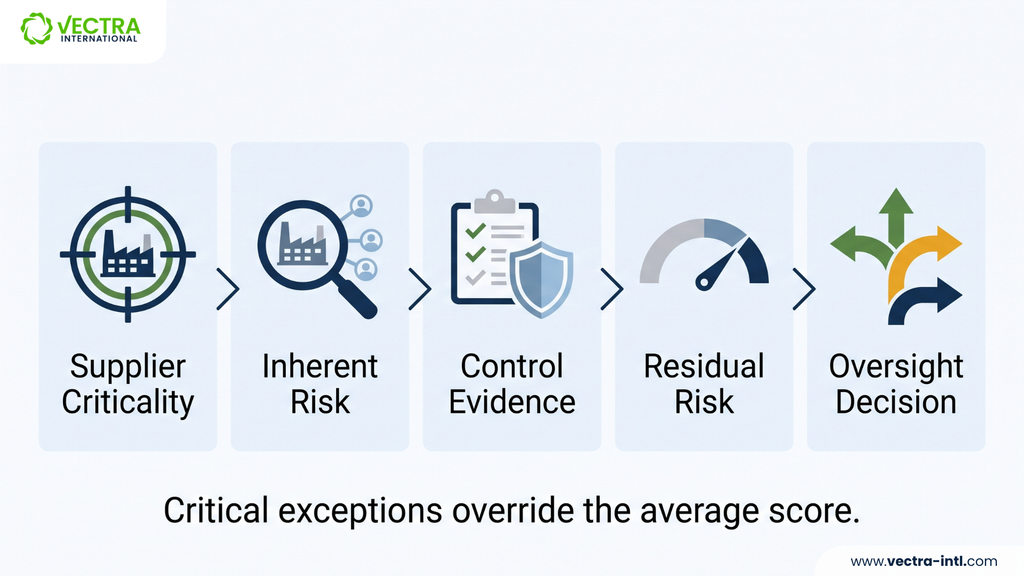
Finally, combine risk with supplier criticality to determine priority. A high residual-risk, critical supplier normally requires immediate senior ownership and a time-bound response. A high residual-risk, noncritical supplier may be replaced. A low residual-risk, critical supplier still needs defined continuity and monitoring because the consequence of failure remains significant.
How Should You Prioritize the Result?
Prioritization should lead to one of four controlled outcomes:
| Outcome | When it fits | Minimum governance |
| Approve | residual risk is within tolerance and no critical exception remains | record the basis, owners, controls, and review triggers |
| Approve with conditions | gaps are controllable and the relationship can proceed within defined limits | actions, due dates, evidence, restrictions, monitoring, and escalation |
| Escalate for deeper due diligence | evidence is missing, conflicting, or specialist judgment is required | named reviewer, focused scope, decision deadline, and interim controls |
| Do not approve or pause | a prohibited condition, severe unresolved impact, integrity concern, or unacceptable residual risk remains | documented rationale, legal review where needed, and controlled communication |
Set non-negotiable rules outside the average score. Examples may include a confirmed sanctions prohibition, refusal to disclose identity, unresolved forced-labor indicators, an unlicensed critical activity, falsified evidence, or a product-safety failure with no effective containment. The exact rules depend on the business and applicable law.
This matters because arithmetic can create false comfort. Nine strong categories should not neutralize one severe, unremedied human-rights impact or one control failure that could stop production. Record critical exceptions separately and make them visible to the decision maker.
What Should Happen After the Assessment?
Every material gap needs a response. Choose among avoidance, substitution, contractual controls, operational controls, capacity building, independent verification, continuity measures, insurance, monitoring, and remediation. The action should address the cause or consequence of the risk, not merely improve the score.
If the supplier can improve, use a controlled plan. VECTRA’s supplier improvement roadmap explains how to turn findings into sequenced actions, accountable ownership, and verified closure. Procurement should make conditions visible in the contract and operating relationship, while technical teams confirm that the control works in practice.
Define reassessment triggers at approval. These may include a change of ownership, new site, new subcontractor, major volume increase, cyber incident, legal action, audit finding, worker grievance, product recall, serious disruption, or material deterioration in performance. Periodic review can be useful, but event-based triggers often identify the moment when an earlier conclusion is no longer reliable.
For high-priority suppliers, VECTRA’s Compliance, Risk & Due Diligence service can support supply-chain mapping, risk assessment, evidence review, and mitigation planning. Where the remaining question requires independent testing of product, process, or site evidence, Independent Quality Assurance can add focused validation to the decision.
In Brief
A supplier risk assessment checklist is useful only when it connects questions and evidence to a clear decision. Start with criticality and scope, evaluate the risk domains that matter to the relationship, distinguish inherent risk from verified controls, and assign a residual-risk tier.
Keep critical exceptions outside the average score. Missing, conflicting, or unverified evidence should remain visible. The final record should state whether the supplier is approved, approved with conditions, escalated for deeper review, or paused, together with the owners and evidence needed for the next decision.
Frequently Asked Questions
What should be included in a supplier risk assessment checklist?
Include supplier identity and ownership, financial stability, operational resilience, quality and product compliance, legal and trade compliance, human rights and labor, environmental exposure, information security, sub-tier and geographic dependencies, governance, evidence, and improvement capacity. Adapt the list to the actual relationship rather than applying every question to every supplier.
How do you calculate a supplier risk score?
Score inherent likelihood and impact first, then assess the effectiveness of verified controls and assign residual risk. Keep supplier criticality as a separate factor that determines attention and oversight. Define each score in plain language and preserve critical exceptions outside any average.
What is the difference between inherent and residual supplier risk?
Inherent risk is the exposure before controls are considered. Residual risk is what remains after the effect of controls has been evaluated using evidence. Planned improvements do not reduce residual risk until they are implemented and verified.
How often should suppliers be reassessed?
Use a frequency proportionate to risk and criticality, then add event-based triggers. Reassess after material changes such as new ownership, sites, products, subcontractors, data access, incidents, audit findings, legal action, or deteriorating performance.
Should every supplier complete the same questionnaire?
No. Begin with segmentation, then apply questions that match the product, service, geography, data access, workforce model, and consequence of failure. A proportionate process improves response quality and allows specialists to focus on higher exposures.
Can a certificate or audit report replace the assessment?
No. A certificate or audit report can support part of the evidence, but its scope, date, criteria, location, and limitations must match the decision. The assessment should integrate relevant evidence and record what remains untested.
View Related Posts
• From “Chat” to “Audit”: The Rise of Agentic AI in Supplier Risk Assessment
• Why Is the Shift From Static to Predictive Risk Scoring Critical in 2026?
• How Can AI Agents Transition Risk Monitoring From Periodic to Continuous?
VECTRA International is a trusted Business Resilience & Operational Capability Building Partner. Through our ecosystem of integrated solutions, we help organizations transform operational complexity into resilient performance, measurable business impact, and sustainable growth.
Chaussée de Wavre 1517B, 1160 Brussels, Belgium.
A Note on Our Visuals: At VECTRA, we combine human expertise with advanced technology. Some of the supportive imagery in this article was generated using artificial intelligence tools like Google Gemini. We ensure all conceptual AI assets align with our brand standards and accurately reflect our data.