An ESG gap analysis identifies where current practice falls short of a defined requirement. Its value appears when those gaps become an owned, sequenced and verifiable pre-audit remediation plan.
A long list of findings does not establish readiness. Teams need a method for deciding what to fix first, which actions depend on others, what evidence proves completion and who has authority to remove each barrier.
What is an ESG gap analysis?
An ESG gap analysis is a structured comparison between the organization’s verified environmental, social and governance practices and a defined set of requirements. It shows where policies, controls, data, implementation or evidence remain incomplete.
The requirements may come from a regulation, reporting framework, customer code, certification scheme, lender request or internal standard. The source matters because a general review cannot produce a reliable readiness conclusion for a specific audit. Every finding should point back to the criterion it addresses.
The current state must also be verified. Policies, procedures and dashboards provide useful evidence, while they may not show whether a control operates consistently. Interviews, source records, samples, approvals and observations help confirm what happens in practice.
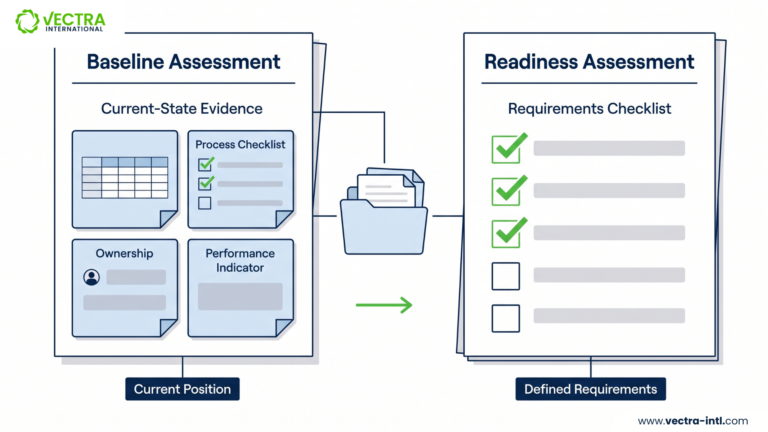
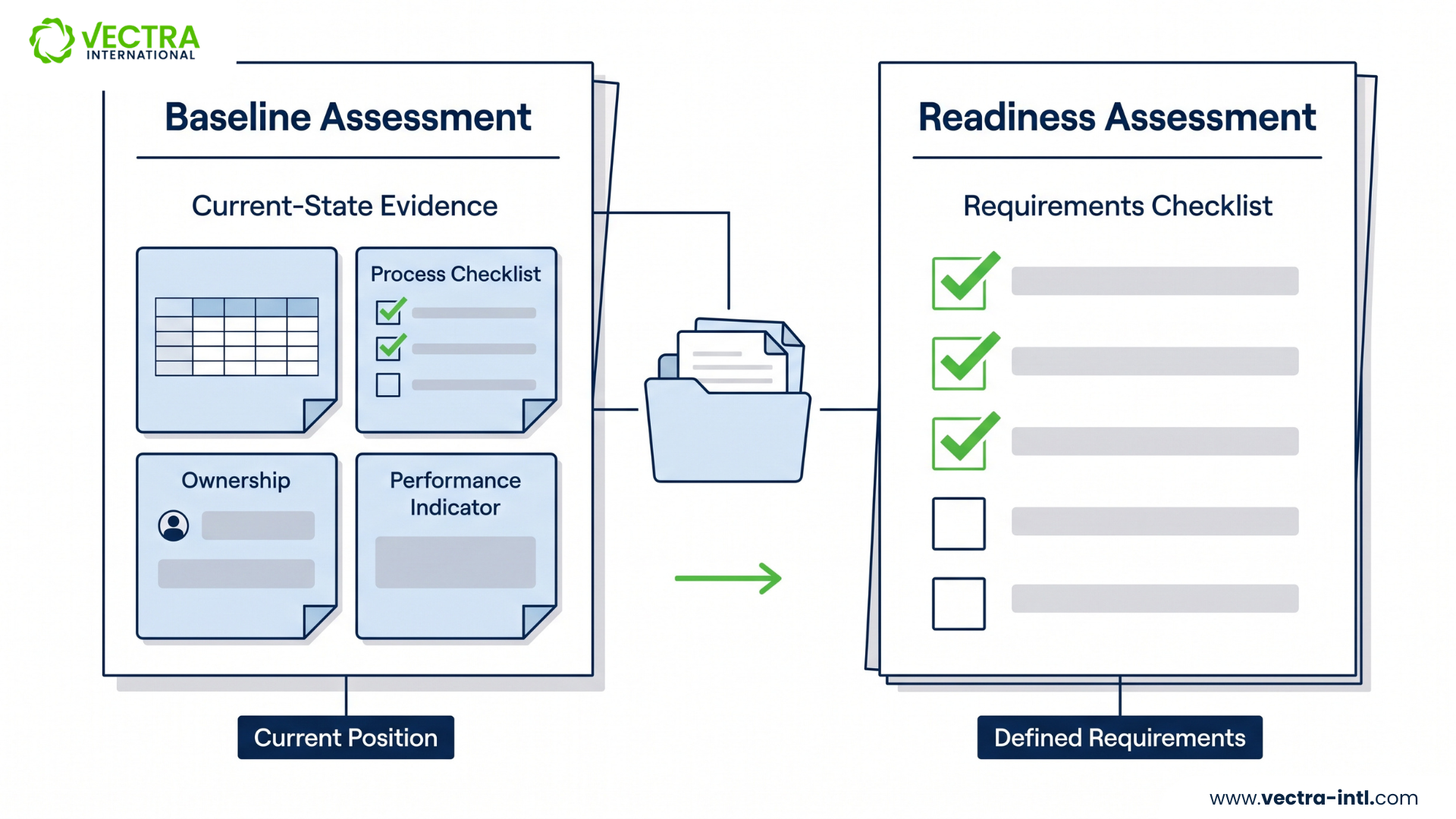
Before beginning the gap analysis, teams should distinguish between a baseline assessment and a readiness assessment (will be linked to Blog 1) so the review starts with the correct purpose, scope and criteria.
What should the ESG gap analysis compare?
The analysis should compare each applicable requirement with the control, implementation evidence and results that demonstrate performance. This creates a traceable line from the criterion to the conclusion.
· Requirement: The exact obligation, expectation or internal commitment being assessed.
· Control: The policy, process, system or decision rule intended to meet the requirement.
· Ownership: The person accountable for operating the control and maintaining its evidence.
· Implementation evidence: The records showing that the control operates across the defined scope and period.
· Performance result: The outcome or indicator showing whether the control is effective.
· Gap statement: The precise difference between the verified current state and the required state.
· Consequence: The impact on people, the environment, compliance, customers, reporting or operations if the gap remains open.
A finding should describe one clear condition. Combining several failures into one paragraph makes ownership difficult and hides dependencies. Separate findings can still share one root cause, which the remediation plan can address through a coordinated action.
How should you prioritize ESG gap analysis findings?
Prioritize findings through a documented rule that considers impact, likelihood, mandatory timing, audit exposure and control dependencies. The rule should direct resources toward the gaps that matter most while preserving the rationale for later review.
For responsible-business impacts, the OECD Due Diligence Guidance for Responsible Business Conduct supports risk-based due diligence across operations, supply chains and business relationships. The approach centers attention on significant adverse impacts rather than the ease or visibility of the corrective task.
Human-rights findings need an additional severity lens. The United Nations Guiding Principles on Business and Human Rights assess severity through scale, scope and irremediable character. This prevents a commercially convenient action from displacing a more serious impact on people.
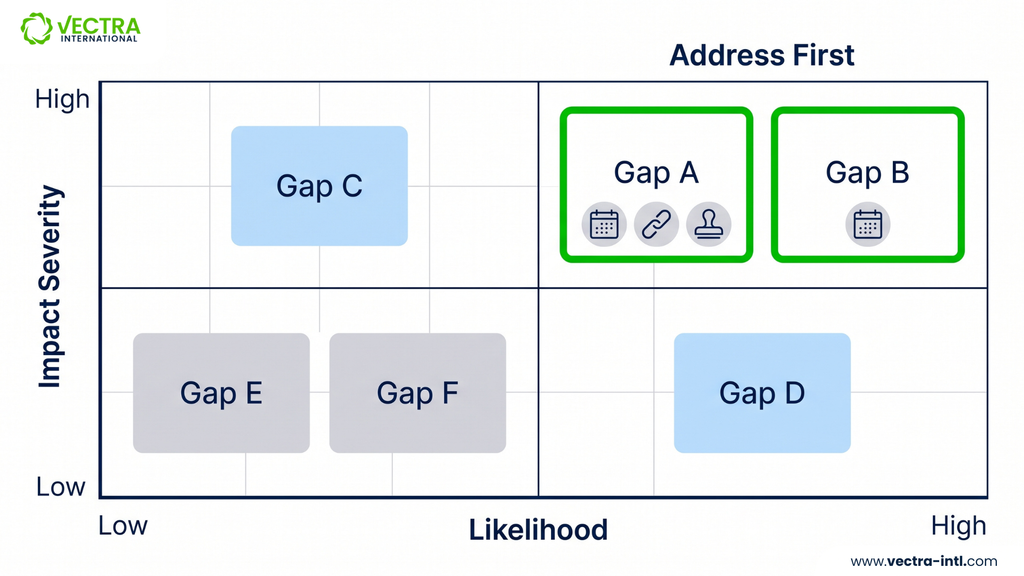
1. Assess impact severity. Consider the seriousness of the environmental, social, governance or operational consequence.
2. Assess likelihood and exposure. Record how plausible the consequence is and where the organization remains exposed.
3. Identify mandatory timing. Note audit dates, customer commitments, regulatory obligations and reporting dependencies.
4. Map control dependencies. Identify gaps whose closure enables several other actions or whose failure weakens multiple controls.
5. Confirm decision authority. Escalate actions that require budget, policy approval, supplier leverage or cross-functional ownership.
6. Document the rationale. Preserve why the priority was assigned, who approved it and when it must be reviewed.
The priority rating should remain open to revision. New evidence can change the understood severity, likelihood or scope. A responsible process records changes and updates the remediation sequence.
How do you turn ESG gap findings into a pre-audit remediation plan?
Turn each material finding into a controlled work item with a root cause, a defined action, a named owner, a completion date, required resources and a verification test. The plan should show how the action changes the underlying system and what evidence will demonstrate that change.
1. Confirm the finding: Validate the requirement, scope, evidence and wording with the people responsible for the process.
2. Determine the root cause : Identify why the gap exists across governance, capability, process design, data, resources or oversight.
3. Define the corrective action : State the specific change required in the control, process, system or behavior.
4. Assign one accountable owner : Supporting teams may contribute, while one person remains responsible for delivery and escalation.
5. Specify completion evidence : Name the documents, records, approvals, data or observations that will prove implementation.
6. Set the verification method : Define who will re-test the action, which sample or evidence will be reviewed and what result counts as effective.
7. Sequence dependencies : Place enabling actions before the tasks that rely on them, and coordinate actions that share one root cause.
8. Approve closure. Close the finding only after the evidence and effectiveness test meet the agreed requirement.
VECTRA’s guidance on pre-audit support explains the value of an independent evidence check before the external review. Independence is particularly useful when the same team designed the control, produced the evidence and assessed its adequacy.
What should every remediation action contain?
Every remediation action should contain enough information for another reviewer to understand the problem, the required change and the evidence of completion. A spreadsheet status cell alone cannot provide that assurance.
| Field | What it should record | Why it matters |
| Finding and criterion | The verified gap and the requirement it affects | Keeps the action tied to the assessment conclusion |
| Root cause | The system, process, capability or governance reason for the gap | Reduces the chance of treating only the visible symptom |
| Corrective action | The specific change, deliverable and intended result | Makes implementation reviewable |
| Owner and support | One accountable owner and the contributing functions | Creates accountability and coordination |
| Due date and dependency | The approved timing and any action that must happen first | Protects the audit timeline |
| Completion evidence | The records that prove implementation | Prevents unsupported closure |
| Effectiveness test | The re-test, sample, observation or result required | Shows whether the corrected control works |
| Escalation rule | The condition that requires leadership action | Moves blocked decisions to the right authority |
How is pre-audit remediation different from a post-audit corrective action plan?
Pre-audit remediation addresses gaps identified before the formal review. A post-audit corrective action plan responds to findings raised during or after the audit. The control principles are similar, while the trigger, authority and available evidence differ.
Pre-audit work gives the organization time to clarify evidence, correct a process and re-test before the external conclusion. Post-audit work may include auditor classifications, formal response deadlines and agreed closure protocols. VECTRA’s article on post-audit corrective action plans covers that later stage in detail.
The two plans should connect. An issue discovered internally should remain visible through audit preparation, and an auditor finding should feed the same governance and improvement system. Separate trackers often create duplicated actions and inconsistent closure evidence.
How should remediation be verified before the audit?
Verification should repeat the relevant part of the readiness test using fresh evidence. The reviewer should confirm that the action was implemented across the stated scope and that the corrected control operates consistently.
· Review the approved corrective action and the requirement it was designed to meet.
· Inspect the completion evidence and confirm its source, date, scope and owner.
· Re-test the control through the method defined in the remediation plan.
· Check whether the action introduced a new gap, dependency or evidence requirement elsewhere.
· Record the result, reviewer, date and any remaining limitations.
· Escalate incomplete or ineffective actions before the formal audit timetable removes the opportunity to correct them.
Closure means that the evidence supports the requirement and the control has passed the agreed effectiveness test. Administrative completion, document upload or management assurance should not replace that standard.
What commonly weakens a remediation plan?
· Vague wording: Actions such as improve awareness or strengthen monitoring do not define a deliverable or test.
· Department-only ownership: A function can support delivery, while accountability still needs one named owner.
· Documentation-only fixes: A new procedure does not prove that the process operates as written.
· Easy-win bias: Completing simple tasks first can leave severe impacts or mandatory requirements exposed.
· Disconnected trackers: Separate registers for assessment, audit, suppliers and operations can hide duplicate or conflicting actions.
· Automatic closure: A completed task does not establish effectiveness until the corrected control is tested.
Where the root cause sits inside supplier or site capability, the supplier improvement roadmap provides a narrower structure for sustained follow-through. The remediation plan should also connect the finding to the wider operating system that allowed it to occur.
How should leadership govern the plan?
Leadership should govern the plan through a regular decision forum that reviews material risks, blocked actions, overdue dependencies and verification results. The forum should focus on decisions that owners cannot resolve within their existing authority.
The view presented to leadership should separate open findings, actions in progress, actions awaiting verification and verified closures. This prevents reported completion from hiding a queue of untested controls.
Operational gaps may require deeper capability work after immediate audit exposure is controlled. VECTRA’s Factory, Farm & Mine Performance Improvement service addresses the processes and capabilities behind recurring site-level issues. VECTRA’s Audit Assistance service supports readiness review, corrective action planning and verification around the audit cycle.
Start with one material finding
Select one material finding from the gap register and trace it through the full chain: requirement, evidence, consequence, priority, root cause, action, owner, completion record and effectiveness test. Any missing element identifies the first improvement needed in the remediation process.
This approach gives the team a practical standard before it scales the plan across the full register. It also reveals whether the organization is managing findings as tasks or controlling them as risks.
| In brief An ESG gap analysis compares verified current-state evidence with defined requirements and records the differences. A pre-audit remediation plan converts each material gap into an action, owner, due date, resource decision, completion record and verification test. Priority should reflect the seriousness and likelihood of the impact, mandatory deadlines, audit exposure and dependencies between controls. Closure requires evidence that the action was implemented and that the control works. |
Frequently asked questions
What is the main output of an ESG gap analysis?
The main output is a traceable gap register that connects each finding to a requirement, current-state evidence, consequence and readiness decision. The register becomes useful when it feeds an owned and verifiable remediation plan.
Should every ESG gap receive the same priority?
No. Priority should reflect impact severity, likelihood, mandatory timing, audit exposure and dependencies. The rationale should be documented so reviewers can understand and challenge the decision.
Who should own a remediation action?
One person with the authority to coordinate delivery should own each action. Several functions may provide evidence, budget, technical input or implementation support, while accountability remains clear.
When is a remediation action complete?
An action is complete when the agreed change has been implemented, the required evidence is available and the corrected control has passed its effectiveness test. Task completion and document submission are intermediate steps.
Can the same plan manage pre-audit and post-audit actions?
Yes. A shared governance system can manage both, provided each action records its source, applicable deadline, reviewer and closure requirement. This creates continuity across assessment, audit and improvement.
Which finding in your current gap register would remain open if closure required proof that the corrected control actually works?
View Related Posts
· How Maturity Assessments Reveal the True State of Your ESG Program
· How to Prepare for ESG Audits: A Complete Guide for Global Supply Chains
VECTRA International is a trusted Business Resilience & Operational Capability Building Partner. Through our ecosystem of integrated solutions, we help organizations transform operational complexity into resilient performance, measurable business impact, and sustainable growth.
Chaussée de Wavre 1517B, 1160 Brussels, Belgium.
A Note on Our Visuals: At VECTRA, we combine human expertise with advanced technology. Some of the supportive imagery in this article was generated using artificial intelligence tools like Google Gemini. We ensure all conceptual AI assets align with our brand standards and accurately reflect our data.