Pre-audit support is an independent check of your audit evidence before the auditor arrives, run by someone who didn’t collect the data. It finds the gaps while you still have the time and authority to fix them. Done properly, it turns your official audit from a first test into a re-test, which leaves you ready for any issues that may arrive.
Most audits don’t fail because a company was hiding something. They fail because evidence is scattered, ownership is unclear, and preparation started too late. The OECD’s Responsible Business Outlook 2026 found the pattern at scale: across the largest 10,000 listed companies, commitments and management systems were common, but an implementation gap remained between what was documented and what was actually in control. Pre-audit support exists to close that gap before it shows up as a finding.
What pre-audit support covers
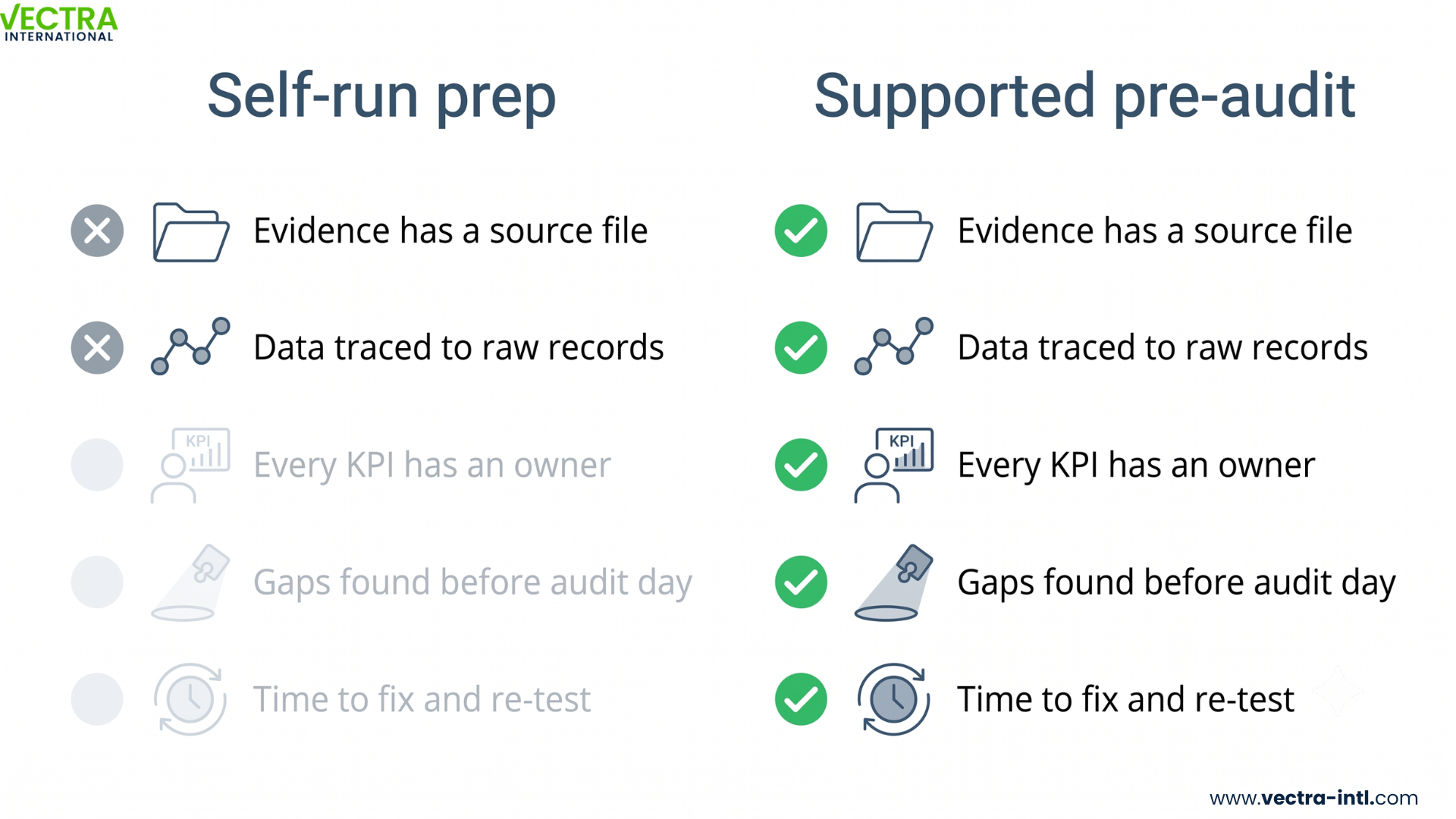
A good pre-audit support engagement is narrow and practical. It matches every metric and claim you’ll be audited on to a source file, so anything without a traceable source gets flagged now rather than on audit day. It samples those numbers and follows them back to raw data, because a trail that breaks in the rehearsal is one you can still fix. It puts a name against every metric and every gap, because an unassigned gap remains a task without a driver. And it leaves a remediation runway: time to fix what turns up, then a re-test to confirm it held.
That’s the core of VECTRA’s Audit Assistance work. If you want the full step-by-step of getting ready, our complete guide to preparing for ESG audits walks through it. This post is about a narrower decision: when to run that prep yourself, and when to bring someone independent in.
Self-run prep vs supported pre-audit support
You can prepare for an audit on your own, and plenty of teams do. The difference is what gets caught.
| Metric | Self-run prep | Supported pre-audit |
| Independence | The people who built the evidence check their own work | An independent reviewer who didn’t collect the data |
| What gets found | The gaps you already suspect | The gaps you can’t see because you’re too close |
| Evidence trail | Spot-checked | Sampled and traced back to source |
| Time to fix | Often too late to change much | Built into the timeline on purpose |
| Result | You hope it holds | You know where it holds and where it doesn’t |
Neither approach is wrong. If your audit is low-stakes and your evidence is already clean, self-prep is fine. The case for support gets stronger as the cost of a surprise finding rises.
When to bring in help
The case for independent help gets stronger in four situations. The first is a multi-tier supply chain, where evidence comes from suppliers and sub-suppliers you don’t control directly and consistency is hard to guarantee. The second is a first CSRD or ESRS reporting cycle, which brings disclosure expectations you’ve never been tested on. The third is repeat findings: if the same issue came back last cycle, the prep meant to close it clearly didn’t hold, and that’s a process problem rather than a paperwork one. The fourth is a new buyer or certification requirement, such as a customer contract or a scheme like SMETA, where “we think we’re ready” isn’t good enough.
What it changes
The point of pre-audit support isn’t a tidier binder. It’s fewer findings, no surprises, and a clear head on audit day.
And when the rehearsal does turn something up, that’s the win, not the failure. A gap found in private becomes an owned action with a deadline and a way to verify it held.
That’s how a finding stops coming back, which we cover in the supplier improvement roadmap and in post-audit corrective action plans. It also connects to the numbers themselves: our companion post on choosing sustainability KPIs that drive decisions shows how to make each metric specific and owned in the first place.
Where the root cause sits inside a factory’s own operations, Factory, Farm & Mine Performance Improvement fixes the capability, not just the record.
Start here
Try one test this week: pick the claim you’re least confident about and ask whether you could trace it to the source in ten minutes. If the answer is no, you’ve found your first pre-audit task.
If you’d rather not run the rehearsal alone, VECTRA’s Audit Assistance puts an independent reviewer on your evidence before the auditor does. Twenty years, 500+ companies, one job: help you get in control.
Frequently asked questions
What is pre-audit support?
It’s an independent review of your audit evidence before the external audit, run by someone who didn’t collect the data. It checks that every claim and KPI has a traceable source, tests a sample back to raw data, confirms ownership, and leaves time to fix what it finds.
Is a pre-audit the same as a mock audit?
A mock audit is one part of it: a full dry run of the audit process. Pre-audit support is broader. It includes the dry run, plus fixing the gaps it exposes and re-testing before the real audit.
When should pre-audit support start?
Early enough to fix what you find. A light evidence check can take days. Repairing a broken data trail or an unclear ownership line usually needs 30 to 90 days.
Do we need pre-audit support if we’ve passed audits before?
Not always. But passing once doesn’t mean the same evidence holds under new rules, a new buyer, or a new auditor. Repeat findings or a first CSRD cycle are the clearest signals to bring in independent help.
What’s the difference between pre-audit support and just preparing internally?
Independence. Preparing internally catches the gaps you already suspect. An independent reviewer catches the ones you can’t see because you’re too close to the evidence.
View Related Posts
- Sustainability KPIs: How to Choose Metrics That Drive Action
- How to Prepare for ESG Audits: A Complete Guide for Global Supply Chains
VECTRA International is a trusted Business Resilience & Operational Capability Building Partner. Through our ecosystem of integrated solutions, we help organizations transform operational complexity into resilient performance, measurable business impact, and sustainable growth.
Chaussée de Wavre 1517B, 1160 Brussels, Belgium.
A Note on Our Visuals: At VECTRA, we combine human expertise with advanced technology. Some of the supportive imagery in this article was generated using artificial intelligence tools like Google Gemini. We ensure all conceptual AI assets align with our brand standards and accurately reflect our data.