Summary
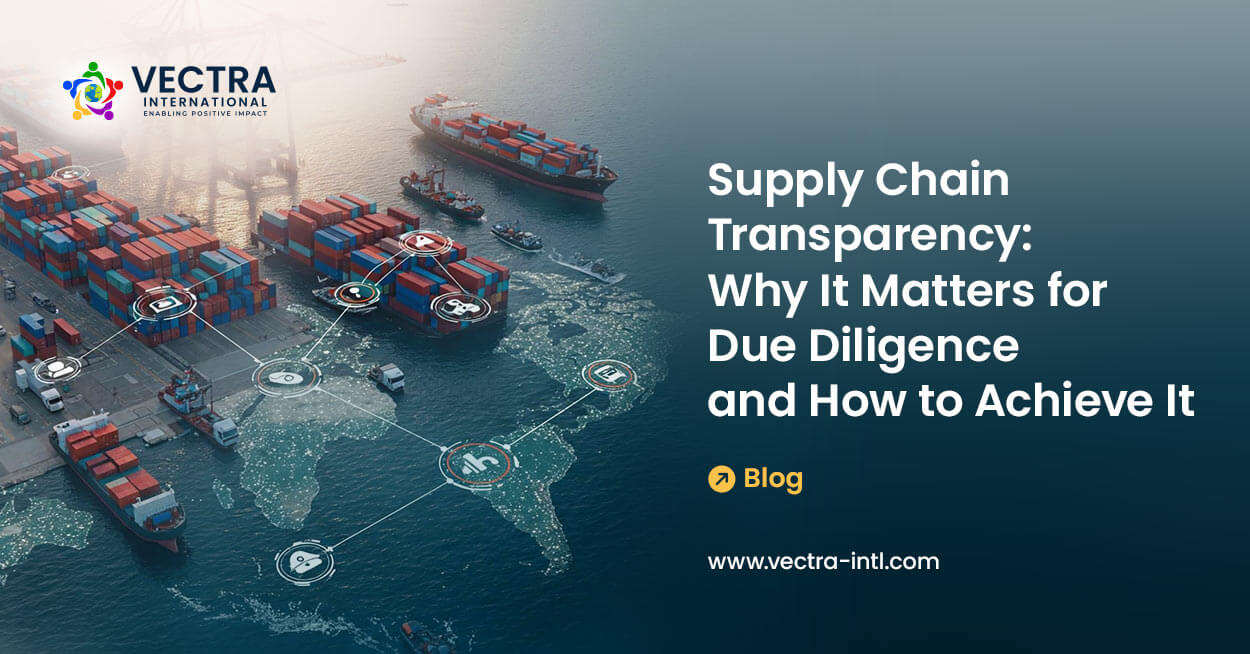
Supply chain transparency has evolved from a competitive advantage to a fundamental business necessity in today’s global marketplace. Therefore, it is important to examine why transparency matters for effective due diligence and what are the practical steps for implementation.
Through a seven-principle framework, real-world examples, and solutions to common challenges, businesses can build more transparent, responsible supply chains that meet stakeholder expectations and drive sustainable growth.
Introduction
Regulatory demands are rising while stakeholders focus more on sustainability and supply chain transparency. Companies are being held accountable not only for their own operations but also for the behavior of their suppliers across multiple tiers.
Transparency is the foundation that enables effective due diligence, risk mitigation, and regulatory compliance in this environment. But what does true transparency actually mean? And how can businesses gain visibility into increasingly complex, global supply networks?
What is Supply Chain Transparency?
Supply chain transparency refers to the disclosure of information about all activities, processes, and relationships along the supply chain. It encompasses knowing who your suppliers are, where they’re located, how they operate, and understanding the environmental and social impacts at each step of the value chain.
While often used interchangeably, transparency differs from related concepts:
- Transparency is about information disclosure and sharing insights with stakeholders.
- Traceability refers to the ability to track materials and products through each stage of the supply chain.
- Visibility focuses on having access to real-time data about supply chain operations.
True transparency requires all three elements working together to create end-to-end understanding and accountability.
Why Do Supply Chain Transparency Matters for Due Diligence?
Supply chain transparency is the practice of openly sharing information about the people, processes, and practices involved at every stage of your supply network. It’s about knowing who your suppliers are, where they operate, and how their practices impact people and the planet—from raw material sourcing to final product delivery.
It’s easy to confuse transparency with other related concepts, but each plays a unique role:
Risk Management and Mitigation
Transparency illuminates risks that might otherwise remain hidden. Without clear visibility, companies can face unexpected disruptions, quality issues, or compliance failures. According to research by McKinsey, companies with transparent supply chains reduce their exposure to risks by approximately 45%.
Regulatory Compliance
The regulatory landscape governing supply chains has grown increasingly complex:
- The EU’s Corporate Sustainability Due Diligence Directive requires companies to identify and address adverse impacts in their supply chains.
- The US Uyghur Forced Labor Prevention Act demands proof that imports aren’t tied to forced labor.
- The UK Modern Slavery Act requires businesses to report on efforts to eliminate slavery from their supply chains.
Without transparency, compliance becomes impossible.
Enhanced Reputation and Brand Value
Today’s consumers and investors favor companies that demonstrate responsible sourcing practices. A 2023 survey found that 73% of consumers would pay more for products from transparent and responsible companies. Supply chain transparency builds trust and enhances brand reputation.
Operational Resilience
The COVID-19 pandemic highlighted how quickly supply chains can unravel when visibility is limited. Companies with transparent supply chains were able to identify alternative sources more quickly and adapt to disruptions with greater agility.
Ethical Sourcing and ESG Performance
Environmental, Social, and Governance (ESG) criteria have become critical factors in investment decisions. Transparency enables companies to verify ethical practices, ensure fair labor conditions, and accurately report their ESG performance.
7 Key Principles for Achieving Supply Chain Transparency
Building real supply chain transparency isn’t just about collecting data—it’s about creating a culture of accountability, visibility, and continuous improvement. These seven principles can guide your organization in developing a transparent, traceable, and trustworthy supply chain.
1. Map Your Supply Chain Comprehensively
You can’t manage what you can’t see. Start by mapping your entire supply chain—from direct suppliers to sub-tier vendors and raw material origins.
- Supplier locations and ownership structures
- Sub-supplier connections and high-risk regions
- Transport routes and logistics partners
- Known ESG risks by geography or product category
Even partial mapping can offer critical insight. Begin with high-priority products or high-risk zones and scale outward.
2. Build a Standardized Data Collection Framework
Transparency depends on reliable, consistent data. Define exactly what you need to collect, how it will be verified, and how often it must be reported.
- Industry-specific data point selection
- Clear supplier reporting templates
- Verification methods (e.g. documentation, site visits)
- Defined cadence for data updates
Collecting focused, actionable data avoids overwhelming suppliers and improves engagement.
3. Define and Communicate Supplier Expectations
Your suppliers can’t meet your transparency goals if expectations are vague.
- Develop and distribute a supplier code of conduct
- Embed transparency clauses in contracts
- Offer onboarding, training, and tools
- Publicly recognize suppliers excelling in transparency
Clear communication builds shared accountability and long-term supplier alignment.
4. Leverage Technology for Real-Time Traceability
Modern supply chains demand modern tools. Technology is key to unlocking both traceability and real-time transparency.
- Blockchain ensures data integrity across product journeys
- IoT devices track environmental or labor conditions live
- AI/ML tools surface supply chain anomalies or patterns
- Cloud platforms centralize and simplify information sharing
Select solutions that match your industry’s scale and complexity.
5. Develop Robust Monitoring and Verification Processes
Transparency without validation is just theory. Put systems in place to ensure what’s reported is accurate.
- Schedule regular supplier assessments
- Use independent audits in high-risk zones
- Monitor transparency KPIs
- Address red flags with quick, structured feedback
This is where transparency becomes trust.
6. Engage Stakeholders Across the Ecosystem
Supply chain transparency is a shared responsibility. Collaborate widely to improve outcomes.
- Involve suppliers in setting transparency goals
- Share updates with customers and investors
- Join industry coalitions or working groups
- Engage NGOs or community leaders near sourcing hubs
Multi-stakeholder engagement increases credibility—and helps solve systemic challenges.
7. Commit to Continuous Improvement
Transparency is not a one-time fix—it’s a long-term discipline.
- Review and refresh your transparency goals annually
- Benchmark against peers and industry leaders
- Scale successful pilots across product lines or regions
- Integrate lessons into broader ESG and risk strategy
Each improvement cycle enhances visibility, resilience, and impact.
Real-World Examples of Supply Chain Transparency
Leading companies across industries are proving that supply chain transparency isn’t just possible—it’s profitable, brand-enhancing, and future-ready. Here are two standout examples that show what’s possible when transparency becomes a core business value.
Patagonia’s Footprint Chronicles
Outdoor apparel company Patagonia demonstrates transparency through its Footprint Chronicles, which allows customers to trace the journey of products from raw materials to finished goods. This initiative has helped Patagonia build exceptional customer loyalty while identifying opportunities for environmental improvements.
Intel’s Conflict Minerals Program
Intel’s approach to sourcing minerals demonstrates how transparency can address complex ethical challenges. By mapping their supply chain to the mine level and conducting thorough due diligence, Intel became the first electronics company to offer conflict-free microprocessors.
How VECTRA International Can Transform Your Supply Chain Transparency
At VECTRA International, we help organizations move beyond fragmented reporting and surface-level insights. We enable end-to-end supply chain transparency that drives resilience, regulatory alignment, and stakeholder trust.
Our approach blends advanced technology with hands-on expertise to turn visibility into strategic value.
- Supply Chain Mapping & Multi-Tier Visibility
- Compliance & Due Diligence Enablement
- Transparency-Driven Technology
- Supplier Engagement & Capacity Building
- Continuous Improvement & Long-Term Support
Transform you supply chain transparency with VECTRA. Contact us today!
Conclusion
Supply chain transparency isn’t optional—it’s foundational. It empowers businesses to conduct meaningful due diligence, meet rising stakeholder expectations, and build supply networks that are ethical, agile, and future-proof.
By applying the above seven principles and integrating the right tools, systems, and partnerships, your business can unlock full visibility across complex supply chains. The journey may involve challenges, but the payoffs are substantial: reduced risk, improved compliance, and lasting trust from customers, investors, and communities alike.
Start with one focused improvement. Whether it’s mapping a high-risk tier or implementing a data collection framework. Over time, these steps compound into a transparent supply chain that not only aligns with your values but strengthens your business at its core.
Ready to begin? VECTRA is here to help you take the first step. Connect with a VECTRA expert today!