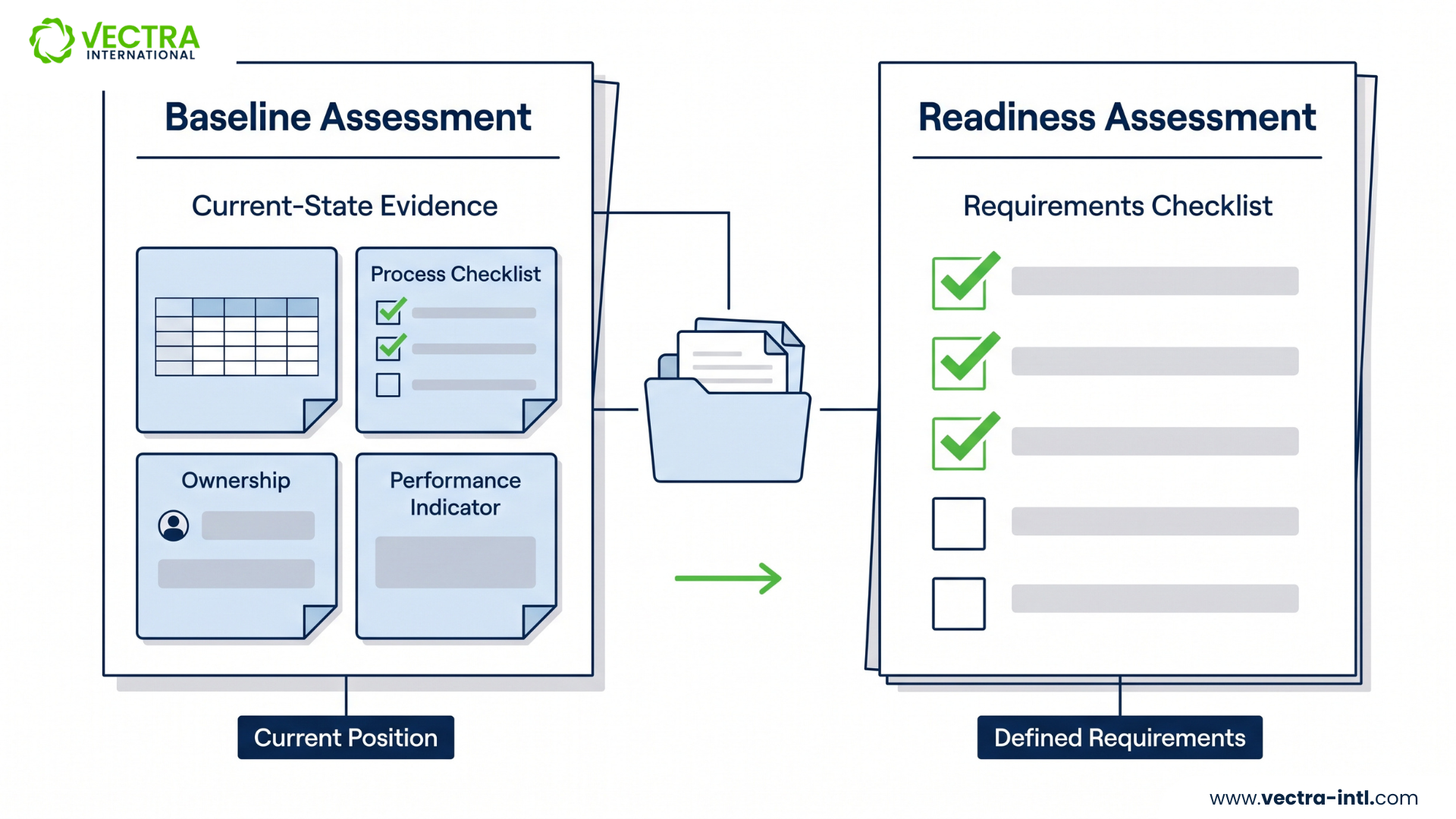
A baseline assessment establishes a documented view of current performance. A readiness assessment then tests whether that current state meets a defined audit, reporting, customer or operational requirement. The distinction matters because each assessment answers a different management question and should produce a different decision.
What is a baseline assessment?
A baseline assessment is a structured record of where an organization stands at a defined starting point. It establishes the facts that later targets, investment decisions and improvement claims will use for comparison.
A useful baseline has boundaries. It states which business units, sites, suppliers, processes, risks and reporting periods are included. It also identifies the criteria used to judge evidence. Without those boundaries, two departments can describe the same organization and produce different answers because they assessed different scopes.
The baseline should capture more than whether a policy or document exists. It should record ownership, implementation, control performance, data quality and the evidence available to support each conclusion. This turns the baseline into a management reference rather than a one-time report.
VECTRA’s existing guidance on ESG maturity assessments explains how governance, processes, data and results can be evaluated together. A maturity assessment may contribute to a baseline, although the two terms are not identical. Maturity adds a progression model that describes how developed a capability has become.
What is a current-state assessment?
A current-state assessment describes how work, controls and evidence function today. It gathers the information needed to establish a baseline and exposes differences between documented procedures and actual practice.
The work may include document review, interviews, process mapping, data tracing and observation. The result should distinguish confirmed facts from assumptions and unresolved evidence requests. That distinction is essential because an assessment becomes unreliable when an unsupported statement receives the same status as verified evidence.
Current-state assessment is therefore best treated as an analytical activity within the wider baseline process. Giving it a separate name is useful only when the scope or deliverable is genuinely different. Otherwise, the organization risks buying or commissioning two exercises that examine the same evidence.
What is a readiness assessment?
A readiness assessment tests whether the organization can meet a defined requirement at a stated point in time. It needs a target such as audit criteria, a buyer code, a reporting framework, a certification requirement or an internal operating standard.
The target changes the assessment. Evidence that supports an internal management decision may still be incomplete for an external audit. A policy may show intent, while an auditor may also expect implementation records, approvals, consistent data, retained evidence and proof that corrective actions were effective.
The current ISO 19011:2026 guidelines for auditing management systems cover audit principles, audit program management and the conduct of management-system audits. The relevant lesson for readiness work is straightforward: the assessment must be tied to stated audit criteria and supported by evidence that can be reviewed consistently.
A readiness assessment should end with a clear decision. The organization should know which requirements are met, which remain exposed, which evidence is missing, who owns each action and how completion will be verified before the external test.
How does a baseline assessment differ from a readiness assessment?
A baseline assessment establishes the starting position, while a readiness assessment evaluates that position against a defined destination. The first supports understanding and planning. The second supports a go, delay, escalate or remediate decision.
| Decision point | Baseline assessment | Readiness assessment |
| Core question | Where do we stand now? | Are we prepared for the defined requirement? |
| Reference point | Agreed scope, indicators and present evidence | Specific audit, standard, buyer, reporting or operating criteria |
| Primary output | Documented starting position and evidence record | Readiness conclusion, gap register and required actions |
| Main use | Planning, target setting, investment and measurement | Audit preparation, certification, disclosure or customer assurance |
| Timing | Before improvement begins or when the existing baseline is unreliable | Before the formal test, with enough time for remediation and re-testing |
The two assessments can share interviews, documents and data. Their conclusions should remain distinct. Combining them in one engagement can be efficient when the report clearly separates the verified current state from the judgment about readiness.
A combined engagement also needs two approval points. Management should approve the baseline before the assessor uses it to judge readiness, then review the readiness conclusion against the stated criteria. This order prevents a disputed starting position from weakening every later gap and action.
The reporting language should make uncertainty visible. Confirmed evidence, partial evidence, unavailable evidence and out-of-scope matters should not be grouped under one score. Recording those distinctions allows leaders to decide whether the immediate need is better data, a stronger control, a wider scope or a formal remediation action.
Which assessment should come first?
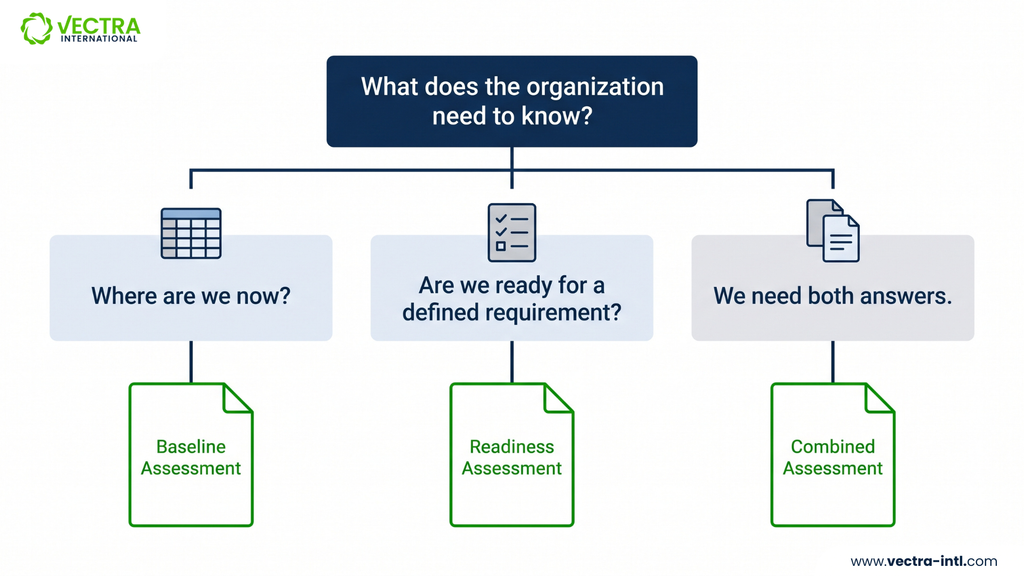
The baseline usually comes first because readiness cannot be judged without reliable current-state evidence. A defined external deadline can change the project design, but it does not remove the need to establish what is true today.
1. Define the decision. State whether leadership needs a starting point, an audit-readiness conclusion or both.
2. Define the target. Record the standard, buyer requirement, reporting framework or internal threshold that will be used.
3. Set the boundary. Confirm the sites, suppliers, functions, topics, systems and reporting periods within scope.
4. Gather and validate current-state evidence. Record what is verified, partly supported, missing or outside scope.
5. Establish the baseline. Approve the starting position and preserve the evidence that supports it.
6. Test readiness. Compare the baseline with every applicable criterion and document the resulting gaps.
7. Assign remediation and verification. Give each material gap an owner, due date, completion evidence and re-test method.
This sequence also supports OECD risk-based due diligence, which expects companies to assess and address significant impacts across operations, supply chains and business relationships. The assessment should help the organization decide where attention and resources are needed.
What should a useful assessment deliver?
A useful assessment leaves the organization with evidence, decisions and accountable next steps. A score without these elements may simplify reporting, but it does not establish control.
· Scope statement: The included entities, operations, suppliers, topics, systems and periods, together with explicit exclusions.
· Criteria register: The requirements, indicators or controls used to evaluate performance, with the source and version recorded.
· Evidence index: The document, dataset, interview or observation supporting each conclusion, including gaps in traceability.
· Current-state findings: Verified strengths, weaknesses, inconsistencies and unknowns stated in neutral language.
· Baseline record: The approved starting position for future comparison, including the date and responsible owner.
· Readiness conclusion: The criteria met, partly met or unmet, together with the effect on the intended audit or decision.
· Gap register: Each gap, its business or impact significance, its owner and the evidence required for closure.
· Remediation route: The actions, dependencies, timing, escalation and verification method needed before completion.
The evidence index deserves particular attention. VECTRA’s guide to pre-audit support explains why an independent review should trace claims back to source records before the auditor arrives. That same discipline strengthens both a baseline and a readiness conclusion.
How do you prevent an assessment from becoming another report?
An assessment leads to action when every material finding is connected to a decision, an owner and a verification method. Leadership should agree on those rules before fieldwork begins.
The report should separate missing evidence from weak performance. A control may operate effectively while its documentation remains incomplete. A complete file may also describe a control that is not implemented consistently. Each condition needs a different corrective response.
Prioritization should reflect impact, exposure, deadlines and dependencies. Easy actions can create momentum, while serious risks and mandatory requirements still need precedence. Once the gaps have been identified, the next step is building a pre-audit remediation plan that assigns ownership, sequences corrective actions and defines how closure will be verified.
Progress should be reviewed through completion evidence rather than status labels alone. A closed action needs proof that the required change was implemented and that the control works under normal operating conditions.
How should leaders choose the right assessment?
Leaders should choose the assessment by the decision they need to make. A team that cannot describe its present controls needs a baseline. A team facing a defined audit, disclosure or customer test needs a readiness assessment. A team in both positions should commission a combined engagement with separate outputs.
· Choose a baseline assessment when targets are being set, an improvement program is beginning, the existing data is disputed or no approved starting position exists.
· Choose a readiness assessment when the organization faces defined criteria and needs to know whether evidence, controls and ownership will withstand review.
· Choose a combined assessment when the deadline is real, the baseline is weak and both the present state and the readiness decision must be established efficiently.
For organizations preparing for an external review, VECTRA’s Audit Assistance service provides a commercial route for evidence review, readiness testing and support before and after the audit.
Start with the decision
Write the decision at the top of the assessment brief before selecting a method. State what leadership needs to know, what criteria will be used, what evidence must support the answer and what action will follow the result. That statement will reveal whether the work needs a baseline, a readiness test or both.
Clear naming will not fix a weak assessment on its own. It will prevent teams from expecting one exercise to answer every question, and it will make the final report easier to use.
In brief
A baseline assessment records the starting position against an agreed scope and set of indicators.
A current-state assessment is the evidence-gathering and analysis used to describe how the organization operates today. It commonly forms part of the baseline.
A readiness assessment compares that current state with a defined future test and identifies the gaps that could prevent success.
The practical sequence is current-state evidence, a defensible baseline, readiness testing, prioritized remediation and verification.
Frequently asked questions
Is a baseline assessment the same as a current-state assessment?
They often cover the same evidence, but the terms describe different roles. Current-state assessment is the work of documenting how the organization operates today. The baseline is the approved reference point produced from that work and used for future comparison.
Is a readiness assessment the same as an audit?
No. A readiness assessment is an internal or advisory evaluation conducted before the formal audit or review. It identifies gaps against the intended criteria and leaves time for remediation and verification.
Can one engagement include both assessments?
Yes. The engagement should produce separate outputs: a verified baseline describing the current state and a readiness conclusion comparing that baseline with defined requirements. Combining the fieldwork can reduce duplication when the scopes align.
How often should a baseline be updated?
The baseline should be reviewed when its underlying scope, operations, suppliers, systems, requirements or evidence have changed enough to make the existing reference unreliable. The review trigger should be defined when the baseline is approved.
What makes a readiness conclusion defensible?
A defensible conclusion has explicit criteria, traceable evidence, documented judgments, clear treatment of missing information and independent review where the stakes justify it. It also states the limits of the assessment.
Which decision does your team need to make next: establish a defensible baseline, or prove readiness against a defined requirement?
View Related Posts
· Sustainability KPIs: How to Choose Metrics That Drive Action
· How to Prepare for ESG Audits: A Complete Guide for Global Supply Chains
VECTRA International is a trusted Business Resilience & Operational Capability Building Partner. Through our ecosystem of integrated solutions, we help organizations transform operational complexity into resilient performance, measurable business impact, and sustainable growth.
Chaussée de Wavre 1517B, 1160 Brussels, Belgium.
A Note on Our Visuals: At VECTRA, we combine human expertise with advanced technology. Some of the supportive imagery in this article was generated using artificial intelligence tools like Google Gemini. We ensure all conceptual AI assets align with our brand standards and accurately reflect our data.