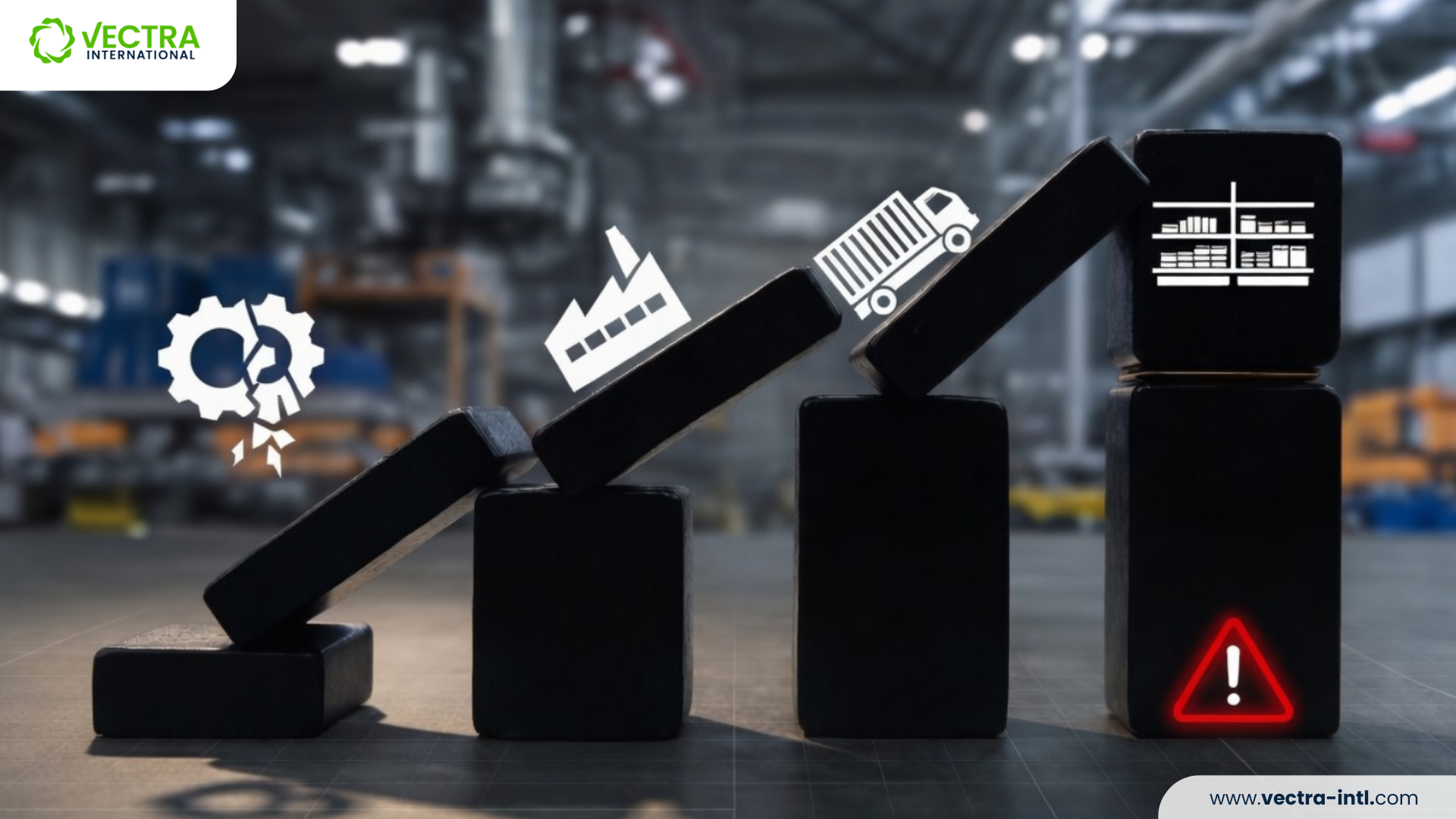
The supply chain risk landscape has fundamentally changed.
In previous years, organizations could rely on annual supplier audits, quarterly risk reviews, and reactive mitigation strategies to manage disruption. In 2026, that approach is no longer sufficient.
Why?
Because the speed of disruption now exceeds the speed of traditional decision-making.
- Billion-dollar climate disasters are occurring approximately every three weeks.
- Geopolitical instability can alter sourcing viability overnight.
- Supplier insolvencies emerge faster due to inflationary pressure, energy volatility, and trade restrictions.
- Regulatory enforcement is becoming increasingly data-driven and immediate.
The era of “snapshot” risk management is ending.
In its place, organizations are moving toward predictive, AI-driven risk intelligence systems capable of identifying supplier failure risks 90–180 days before disruption occurs.
For supply chain leaders, this shift is not optional. It is operational survival.
The Problem with Static Risk Management
Traditional supply chain risk scoring has historically operated like a photograph:
- A supplier is audited once or twice a year.
- Risk is scored based on historical performance.
- Reports are reviewed manually.
- Decisions rely heavily on experience and instinct.
This model worked when supply chains moved slower and disruptions were more localized.
But in 2026, supply chains operate in a permanently volatile environment where risk conditions evolve daily.
A supplier deemed “low risk” in January may face:
- Political sanctions by March
- Labor unrest by April
- Financial distress by June
- Climate-driven production shutdowns by July
Static scoring cannot adapt fast enough.
And when visibility lags reality, organizations enter crisis mode.
Why Predictive Risk Scoring Matters Now
The companies outperforming in 2026 are shifting from retrospective analysis to predictive intelligence.
Instead of asking:
“What went wrong?”
They are asking:
“What is likely to go wrong next?”
This is where machine learning and predictive analytics are transforming supply chain resilience.
Modern predictive risk scoring systems continuously analyze:
- Supplier financial health
- Shipment delays
- Weather disruptions
- Geopolitical developments
- ESG violations
- Customs enforcement trends
- Commodity pricing volatility
- Cybersecurity incidents
- Logistics bottlenecks
The goal is not simply monitoring.
The goal is early-warning detection.
From Gut Feel to Data-Driven Decision-Making
For decades, supply chain leadership relied heavily on institutional knowledge and instinct.
Experienced procurement leaders could often “sense” supplier instability before it appeared in reports.
But today’s supply chains are too complex for intuition alone.
Organizations now manage:
- Thousands of suppliers
- Multi-tier sourcing ecosystems
- Cross-border regulatory exposure
- Real-time geopolitical disruptions
No leadership team can manually process that volume of risk signals effectively.
Predictive models help identify hidden correlations humans may miss.
For example:
- Declining on-time shipment performance combined with rising energy costs may indicate future supplier liquidity stress.
- Increased port congestion near a supplier’s region may predict inventory shortages months in advance.
- Sudden spikes in labor turnover data may signal production instability before operations fail.
This is not replacing human expertise.
It is augmenting it with machine-scale intelligence.
The Tier-2 Visibility Crisis
One of the biggest weaknesses in modern supply chains remains Tier-2 and Tier-3 visibility.
Most organizations have relatively strong oversight of direct suppliers.
But risk frequently originates deeper in the network:
- Raw material shortages
- Sub-supplier insolvencies
- Conflict-region exposure
- Forced labor risks
- Environmental non-compliance
In many cases, companies do not discover these vulnerabilities until production has already been impacted.
Predictive risk scoring changes this dynamic by aggregating data across multiple tiers and continuously identifying emerging weak points.
This creates a critical capability:
anticipating disruption before it reaches Tier-1 operations.
The Rise of the “Single Source of Truth”
A major reason organizations struggle during disruption is fragmented data.
Procurement uses one platform.
Logistics uses another.
Compliance teams maintain spreadsheets.
Finance operates independently.
ESG data sits elsewhere.
The result is inconsistent decision-making and delayed response times.
Predictive risk scoring only works when organizations establish a unified data foundation.
This means creating a “single source of truth” that integrates:
- Supplier master data
- ERP systems
- Logistics feeds
- Risk intelligence platforms
- ESG reporting
- Trade compliance data
- Financial indicators
Without integration, predictive models become unreliable.
With integration, leaders gain real-time operational clarity.
Moving from Reactive Firefighting to Proactive Resilience
The traditional supply chain model has often been reactive:
- Disruption occurs
- Teams scramble
- Emergency mitigation begins
- Costs escalate
Predictive risk scoring enables a different operating model:
- Early warning signals emerge
- Risk thresholds trigger alerts
- Alternate sourcing scenarios activate
- Mitigation begins before failure occurs
This transition dramatically improves:
- Production continuity
- Working capital efficiency
- Customer reliability
- Regulatory preparedness
- Executive decision confidence
In 2026, resilience is increasingly measured by how early organizations can detect instability—not simply how fast they react afterward.
What Leaders Should Prioritize Now
To successfully transition toward predictive risk management, organizations should focus on five priorities:
1. Consolidate Data Infrastructure
Disconnected systems weaken predictive accuracy.
2. Expand Multi-Tier Visibility
Tier-2 and Tier-3 suppliers must become part of risk intelligence frameworks.
3. Invest in Explainable AI
Executives need transparent, interpretable risk indicators—not black-box outputs.
4. Build Cross-Functional Governance
Procurement, compliance, operations, and finance teams must operate from the same risk framework.
5. Simulate Disruption Scenarios
Organizations should regularly stress-test supplier failure scenarios before real-world crises occur.
The Future of Supply Chain Risk Management
The defining supply chain advantage of the next decade will not simply be scale or cost efficiency.
It will be predictive resilience.
Organizations that continue relying on static audits and reactive processes will face:
- Longer recovery cycles
- Higher operational costs
- Increased regulatory exposure
- Greater production volatility
Meanwhile, organizations investing in predictive intelligence will gain:
- Faster decision-making
- Better supplier continuity
- Reduced disruption costs
- Greater executive confidence during crises
In 2026, the question is no longer whether disruption will occur.
The question is whether your organization will see it coming early enough to act.
View Related Posts
Would Your Supply Chain Survive the 2026 Ban on the Destruction of Unsold Goods?
How Does Fragmented Data Create “Ghost Risks” in Your Tier-2 Supply Chain?
VECTRA International is a global expert in Supply Chain Risk & Responsibility. We positively impact businesses, their workers, and communities by helping create better, more efficient supply chain workplaces.
Chaussée de Wavre 1517B, 1160 Brussels, Belgium.