Summary
CDP reporting in 2025 is essential for ESG transparency, investor engagement, and climate leadership. This guide outlines the latest CDP requirements, timelines, scoring criteria, and best practices.
Learn how the CDP AI Partner simplifies disclosure, reduces reporting time, and improves score performance. This makes CDP reporting faster, smarter, and more impactful.
Introduction
Corporate environmental reporting in present times has a lot of weight. As we navigate 2025, the Carbon Disclosure Project (CDP) continues to be the world’s most comprehensive environmental disclosure system, with nearly 25,000 companies, worth two-thirds of global market capitalization, disclosed through CDP in 2024.
Understanding CDP Reporting: What You Need to Know
The Carbon Disclosure Project operates as a global environmental disclosure system that enables companies to report their environmental impacts across three key areas: climate change, deforestation, and water security.
Reporting to the CDP is not mandatory; companies typically disclose their impacts through the CDP when a stakeholder (E.g. supplier) requests it.
Key CDP Reporting Requirements for 2025
The 2025 full corporate and SME questionnaires have minimal changes compared to last year. Meanwhile, our scoring methodology remains stable with improvements in wording for clarity and consistency of scoring.
This stability provides companies with a predictable framework for their environmental disclosures.
Primary Reporting Categories:
- Climate Change: Greenhouse gas emissions, climate risks, and mitigation strategies
- Deforestation: Forest risk commodities and supply chain impacts
- Water Security: Water usage, risks, and management practices
CDP Disclosure Cycle 2025 Timeline
The response window for the 2025 disclosure cycle is currently open, providing companies with the opportunity to demonstrate their environmental transparency. Organizations should begin their preparation early to ensure comprehensive and accurate reporting.
Why CDP Reporting Matters in 2025
Environmental disclosure has become increasingly important as stakeholders demand greater transparency. Within two years of an investor request, companies disclosing through CDP reduce their direct emissions by 7-10% on average, demonstrating the real-world impact of transparent reporting.
Stakeholder Expectations
Stakeholders are increasingly requesting environmental data through CDP. These requesters include capital markets, large purchasing organizations who are Supply Chain members, Banks program members, and membership/initiatives such as RE100. This growing demand makes CDP reporting essential for maintaining stakeholder relationships and accessing capital.
Regulatory Compliance
As environmental regulations tighten globally, CDP reporting provides a framework for compliance with emerging climate disclosure mandates. Companies that proactively engage with CDP reporting often find themselves better prepared for regulatory requirements.
CDP Scoring and Performance Metrics
CDP reporting requirements vary by industry and company size, but all participating companies must disclose emissions and energy consumption data. Third-party verification of scope 1, 2, and 3 emissions is critical to achieving a high score on CDP disclosures.
Scoring Methodology
The CDP scoring system evaluates companies on four progressive levels:
- Disclosure (D): Company provides basic information
- Awareness (C): Company shows understanding of environmental issues
- Management (B): Company demonstrates coordinated action
- Leadership (A): Company shows best practices and leadership
Key Performance Indicators
Companies should focus on these areas to improve their CDP scores:
- Complete and accurate data collection
- Third-party verification of emissions data
- Clear climate targets and strategies
- Evidence of progress toward goals
- Integration of environmental considerations into business strategy
Best Practices for CDP Reporting in 2025
1. Early Preparation and Planning
Setting clear internal deadlines, milestones, and team responsibilities early on will be crucial for efficient data collection and reporting. Organizations should begin their CDP preparation months in advance to ensure comprehensive data collection.
2. Data Quality and Verification
Accurate data forms the foundation of effective CDP reporting. Companies should implement robust data collection systems and consider third-party verification for Scope 1, 2, and 3 emissions to enhance credibility.
3. Integration with Other Reporting Frameworks
It’s also important to consider how CDP reporting will align with other reporting initiatives, such as TCFD, GRI, or SASB frameworks. This alignment reduces duplication and creates a more cohesive sustainability narrative.
4. Technology and Automation
Modern CDP reporting increasingly relies on technology solutions to streamline data collection and analysis. AI-powered platforms can help organizations identify data gaps, automate calculations, and ensure consistency across reporting periods.
Common Challenges and Solutions
Data Collection Complexity
Many organizations struggle with collecting comprehensive environmental data across global operations. Solutions include:
- Implementing centralized data management systems
- Training local teams on data collection protocols
- Using automated monitoring systems where possible
- Engaging with suppliers for Scope 3 emissions data
Resource Allocation
CDP reporting requires significant resources and expertise. Organizations can address this by:
- Dedicating specific team members to sustainability reporting
- Investing in training and development
- Leveraging external expertise when needed
- Using technology to streamline processes
Stakeholder Engagement
Effective CDP reporting requires buy-in from across the organization. Best practices include:
- Securing leadership commitment
- Communicating the business value of environmental reporting
- Involving relevant departments in data collection
- Creating accountability mechanisms
Leveraging Technology for CDP Success
The complexity of CDP reporting in 2025 demands sophisticated technology solutions. Organizations increasingly turn to AI-powered platforms that can automate data collection, identify inconsistencies, and provide insights for improvement.
Advanced reporting platforms can help organizations:
- Streamline data collection across multiple sources
- Ensure consistency with CDP requirements
- Generate insights for strategic decision-making
- Prepare for future reporting cycles
For organizations seeking comprehensive CDP reporting solutions, platforms like VECTRA International’s CDP AI Partner offer specialized capabilities designed to simplify the reporting process while ensuring accuracy and compliance with CDP requirements.
How VECTRA International Helps in CDP Reporting 2025
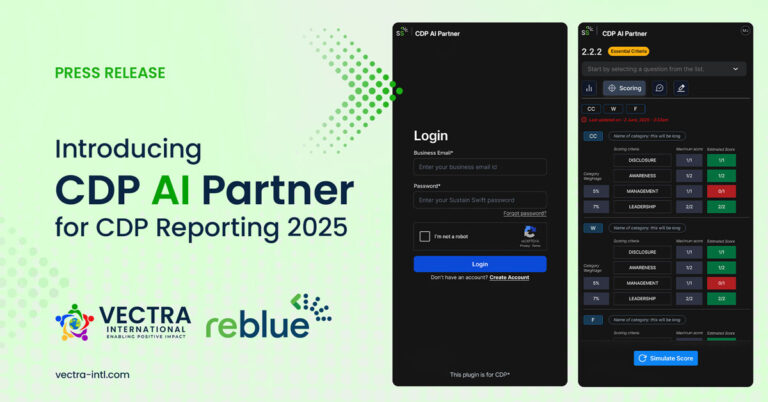
With increasing importance for CDP Reporting comes increase in less clarity. Therefore, VECTRA International partnered with Reblue Ventures to design an AI plugin that can help businesses report for the 2025 CDP cycle.
CDP AI Partner is an AI-powered web plugin that runs alongside the official CDP portal. This plugin helps businesses:
- Reduce CDP reporting time
- Increase data clarity
- Collaborate via the tool
- Clear dashboard
- Score simulations
- Peer benchmarking
We are also offering a free trial of the CDP AI Partner till 31st July. This free trial includes the climate change module 2.
Conclusion
CDP reporting in 2025 is not just a compliance exercise—it’s a strategic driver for corporate transparency, stakeholder trust, and climate leadership. As environmental regulations tighten and investor expectations rise, companies that engage proactively with the CDP framework are positioning themselves for long-term value and competitive advantage.
This year’s stability in scoring methodology presents an opportunity for businesses to refine their reporting processes, enhance data quality, and strengthen internal systems. With tools like VECTRA International’s CDP AI Partner, organizations can reduce the complexity, time, and resource burden of disclosure, while improving accuracy and alignment with best practices.
By investing in early preparation, leveraging automation, and integrating CDP reporting into broader ESG strategies, businesses can not only meet today’s demands—but lead the conversation on environmental performance for years to come.