Consider responsible disengagement when serious harm continues and the supplier has no credible path to stop it, when harm cannot be prevented or mitigated through continued engagement, or when the law requires you to stop. Before ending the relationship, assess whether leaving could put workers at greater risk and how any outstanding remedy will be handled. If people face immediate danger, act to protect them now; don’t wait for the exit review to finish.
Imagine your team has approved two corrective action plans for a supplier. Each time, the factory submits new policies and marks the action complete. Then you hear from workers recruited through an agency: they are still carrying debt from recruitment fees, and some fear losing their jobs if they speak up. Procurement wants to switch suppliers. The responsible sourcing lead asks a question that changes the meeting: if we move the orders tomorrow, who will make sure those workers are repaid?
What Is Responsible Disengagement?
Responsible disengagement means ending a business relationship while taking steps to address the original harm and limit harm caused by the exit. Restrictions or a suspension can come first, but neither is the same as ending the relationship. A contract termination notice tells a supplier when the commercial relationship ends. An exit plan also establishes what happens to workers, outstanding remedy, and safeguards after the notice goes out.
The OECD Due Diligence Guidance for Responsible Business Conduct, section 3.2 and Annex Q39, treats disengagement as generally a last resort. It identifies circumstances that can justify leaving, including failed attempts to prevent or mitigate severe impacts, no reasonable prospect of change, irremediable impacts, or a failure to act promptly on severe issues. It also asks companies to consider the effects of leaving. Last resort does not mean you must give a supplier one more chance in every case. If the relationship cannot lawfully continue or people need immediate protection, the usual review timetable should not govern the response.
Separate the business decision from the impact decision. For example, the supplier may be hard to replace and stopping orders could disrupt deliveries. That matters for continuity planning. It does not reduce the seriousness of harm to workers. VECTRA’s human rights due diligence guide explains how to assess severity and how the buyer’s connection to an impact affects the response.
When Should You Keep Working With a Supplier, Suspend Orders, or Exit?
Start with the current facts. Identify the people and sites affected, the activities involved, and whether the harm is ongoing. Check which activities a buyer can restrict and what restrictions might expose workers to retaliation or loss of income. Ask legal counsel to review the applicable requirements and contract terms. Ask the responsible sourcing team to test the supplier’s account against safe worker input and other evidence where feasible. Do not give the person implicated in a grievance control of the verification.
| Decision | When it can fit | What the buyer should require |
| Continue under conditions | The harm can be stopped or reduced, and there is credible evidence that the supplier is acting. Continued engagement does not breach a requirement or leave an immediate threat unmanaged. | A time-bound action plan, independently checkable milestones where appropriate, and a consequence if progress stops. |
| Restrict or suspend | Continuing the affected activity would add to the risk, or the facts are too serious to leave the relationship operating as usual while they are verified. | A defined scope of restriction, protection for workers, a review date, and evidence required for any resumption. |
| Disengage | The law requires an end, harm is irremediable, the supplier will not take necessary action, or there is no credible route to prevent or mitigate the impact through continued engagement. | A documented rationale, a review of exit impacts, and an owner for open safeguards and remedy. |
The scope of a restriction matters. If the concern involves one labor agency at one site, a buyer could halt new recruitment through that agency or freeze new orders for the affected lines, subject to legal review and what is needed to protect workers. That is different from telling the factory to stop paying people or cutting their hours. If restrictions cannot prevent further harm, broaden the protective response as the facts and law require. Keep VECTRA’s supplier engagement guide as the companion for gathering evidence and setting monitored milestones while engagement is still viable.
What Counts as Credible Progress?
Credible progress is a change you can verify in the affected people’s situation or in the control that prevents recurrence. It is not another reminder email, a policy file, or a corrective action marked complete by the supplier. The International Labour Organization’s fair recruitment guidance states that workers should not bear recruitment fees or related costs directly or indirectly. A new policy may help prevent future fees, but it cannot prove that workers who already paid have received reimbursement.
If the supplier says it reimbursed every worker who paid, check the people, time period, and evidence:
· Reconcile the lists. Match the supplier’s repayment list against the recruitment roster.
· Account for departures. Look for workers who have left and verify outcomes without exposing them to harm.
· Check who controls reporting. If the agent accused of charging fees handled repayments, make sure workers can report shortfalls without going back through that agent.
Use VECTRA’s guide to worker grievance mechanisms to check who receives reports, how workers get updates, and whether the complaint route will still function during an exit.
Put time limits on the decision, not just the corrective action plan. An agreed date should trigger a review of the evidence and a decision about what happens next. If evidence is missing, explain what you still need and who can make the decision to extend, restrict, or exit. VECTRA’s guide to closing pre-audit remediation gaps can help structure ownership and verification. For harm to workers, administrative closure is not a substitute for checking whether remedy reached them.
How Should a Buyer Use Its Leverage Before Leaving?
Leverage is the buyer’s ability to influence the supplier’s behavior. That can come from purchasing terms, future orders, technical assistance, or coordinated action with others where appropriate. Test whether the leverage is credible and likely to improve the outcome. A buyer that threatens to leave but keeps increasing the supplier’s orders may be sending the opposite message.
Look at what your own team can change. If last-minute orders, unrealistic lead times, or commercial terms contributed to the harm, fixing only the supplier’s process leaves the buyer’s part untouched. VECTRA’s responsible purchasing practices guide connects buyer behavior to conditions at the site. When qualifying a replacement or reopening a tender, use sustainable procurement at the award stage [LINK TO SUSTAINABLE PROCUREMENT] to check that the new price and timeline do not recreate the same pressure.
The UN Guiding Principles on Business and Human Rights, particularly Principles 19 and 22, distinguish between harm a company causes or contributes to and harm directly linked through a business relationship. If your company caused or contributed to the harm, it should provide for or cooperate in remedy through legitimate processes. Where the impact is directly linked and the buyer did not contribute, it should use leverage to seek prevention or mitigation as appropriate; it may still have a role in supporting remedy. Assess the facts and applicable obligations rather than assuming termination settles the question.
What Should a Responsible Disengagement Plan Include?
Write the plan while you still have people, records, and decision-makers available. Compare what could happen if you stay under controls, if you restrict certain activities, and if you leave. Where it is safe and feasible, seek input from affected workers or legitimate representatives without routing sensitive conversations through people who could retaliate. If it is not safe to consult directly, get specialist advice on alternative routes. Build the following into the plan:
· Decision and scope. Identify the supplier entity, site, orders, agencies, and activities affected. Record who approved the decision, the reason, and whether a broader stop is needed to protect people or meet legal requirements.
· Worker protections. Plan for risks such as retaliation, unpaid wages, lost access to reporting channels, or consequences for workers whose housing or immigration status depends on the job. Name who will monitor the risks and what should trigger escalation.
· Outstanding remedy. Record what is still owed or unresolved, who is responsible for each action, how affected people will be reached safely, and what will count as proof. Limit access to identifying information and keep only what is needed and lawfully held.
· Transition and follow-up. Specify notice where lawful, safe, and feasible; outstanding orders; payment and transition arrangements; the review dates; and who will act if a promise is missed after the final order.
The UN Global Compact’s guidance on responsible exit is a useful companion when planning how purchasing decisions affect workers and communities. In practice, do not assume a notice period always helps. It can give time for remedy and transition, but it can also expose workers to retaliation if the supplier learns who reported a concern. Involve the right legal and safeguarding expertise before communicating in a way that could increase harm.
Be specific about who owns closure after the contract ends. While orders are still open, the category manager may be able to secure records and agree on who will fund follow-up. After exit, responsible sourcing or an independent partner may be better placed to keep in touch with affected workers. Put those arrangements in place before handover where feasible. Give the person taking over access to the evidence they need, not the whole grievance file, and make sure they have a route to escalate an unpaid remedy or a new report of retaliation.
What Should You Write in the Decision Record?
Give the approver three things in the decision record:
· What you verified ? Identify the evidence you relied on and what remains uncertain.
· Why did you choose this action? Explain why it is more likely to protect workers than the alternatives you rejected.
· What does it means for supply?. If procurement proposes staying because the supplier is hard to replace, record that continuity risk separately from the evidence that workers will be protected.
That distinction lets the approver challenge a weak mitigation plan without losing sight of continuity.
Set a specific trigger to reopen the decision. For example, the case owner might escalate immediately if the supplier contacts complainants in breach of the agreed safeguards or if formerly employed workers lose access to the reporting route. Log who receives that escalation and who has authority to act. The decision record should make it possible to respond on the day a condition fails rather than waiting for the next supplier committee meeting.
Worked Example: Recruitment Fees Remain Unpaid
In this illustrative case, the supplier says it reimbursed all affected recruits. The buyer reviews the agency roster: 24 workers are in scope, but the available records cover 18. An independent worker-facing partner confirms that some payments were received and that some former workers cannot access the factory’s reporting channel. The supplier supplies a new recruitment policy, but it cannot explain the six missing files. The buyer now has evidence of partial progress and a gap that matters. It does not yet have evidence that all 24 workers were made whole.
The buyer stops new recruitment through the affected agency where it can do so without exposing workers to greater harm, preserves the records lawfully, and arranges a confidential route that former workers can use. Procurement and responsible sourcing agree on what the next review must establish: who was charged, what remains unpaid, and what proof can safely confirm repayment. The category manager checks whether the sourcing terms contributed to the agency arrangement. If they did, the buyer changes those terms and assesses what it needs to do about the harm it helped create.
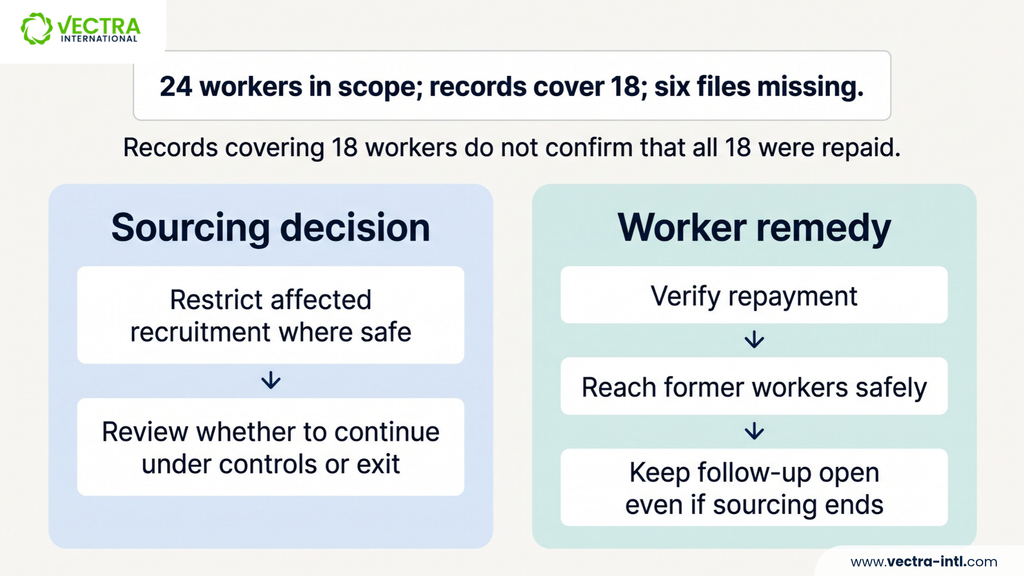
Illustrative recruitment-fee case: review whether to keep sourcing, but keep verifying repayments and following up with workers even if sourcing ends.
At the next review, the decision turns on results. If the supplier helps locate former workers without coercion, provides reliable evidence, and addresses the causes of recurrence, the buyer can consider continuing under defined controls. If the supplier blocks access, retaliates, or repeatedly fails to address the remaining harm, the buyer has a stronger basis to exit, subject to any action that must be taken sooner. If the buyer exits, it still assigns a person to monitor the open remedy actions, confirms how former workers can reach the case handler, and records the consequences if milestones are missed. Moving the purchase order is not the test of whether the workers were repaid.
Before You Decide to Exit
Take one supplier with an overdue high-risk action. Ask what people are experiencing now, what evidence would justify continuing, and who will own the open actions if you stop sourcing next week. If nobody can answer the last question, build that part of the plan before sending the notice, unless urgent protection or legal obligations require immediate action. For complex cases, VECTRA’s Compliance, Risk & Due Diligence service can help your team review the evidence, define escalation criteria, and set up follow-up that survives the sourcing decision.
Frequently Asked Questions About Responsible Disengagement
Is Responsible Disengagement Always a Last Resort?
Generally, yes, under the OECD guidance. It is not an instruction to continue an unlawful relationship or delay urgent protection. Severity, prospects for change, the buyer’s connection to the impact, the consequences of leaving, and applicable obligations all matter. Document why further engagement is or is not likely to reduce harm.
Does a Failed Corrective Action Plan Mean You Should Terminate the Supplier?
No. A missed deadline may call for tighter controls, independent verification, or suspension. Repeated failure, no credible implementation, ongoing severe harm, and retaliation are stronger reasons to escalate toward exit. Decide based on the real effect of the response and the risk of continuing, not the status in an audit tracker.
Can a Buyer Suspend New Orders Without Ending the Whole Relationship?
It may be possible, depending on the facts, contract, and applicable law. A targeted restriction can prevent additional exposure while leaving room for immediate protection and remedy. Specify the scope, consider how the restriction may affect workers, and require evidence before allowing the activity to resume.
Does Responsibility End When the Contract Ends?
Not automatically. Ending a contract does not undo harm, and the company’s role in remedy depends on how it was connected to the impact and on applicable obligations. Assign ownership for open actions and safe follow-up after exit. Check that a grievance route remains available even to workers who no longer have site access.
View Related Posts
· Human Rights Due Diligence: How to Assess and Prioritize Supplier Impacts
· Supplier Engagement: How to Get Better Evidence and Close Risk Gaps
· ESG Gap Analysis: How to Build a Pre-Audit Remediation Plan
VECTRA International is a trusted Business Resilience & Operational Capability Building Partner. Through our ecosystem of integrated solutions, we help organizations transform operational complexity into resilient performance, measurable business impact, and sustainable growth.
Chaussée de Wavre 1517B, 1160 Brussels, Belgium.
A Note on Our Visuals: At VECTRA, we combine human expertise with advanced technology. Some of the supportive imagery in this article was generated using artificial intelligence tools like Google Gemini. We ensure all conceptual AI assets align with our brand standards and accurately reflect our data.