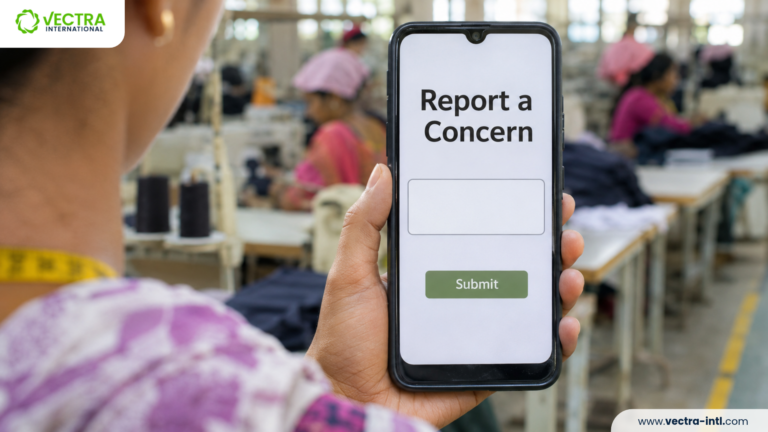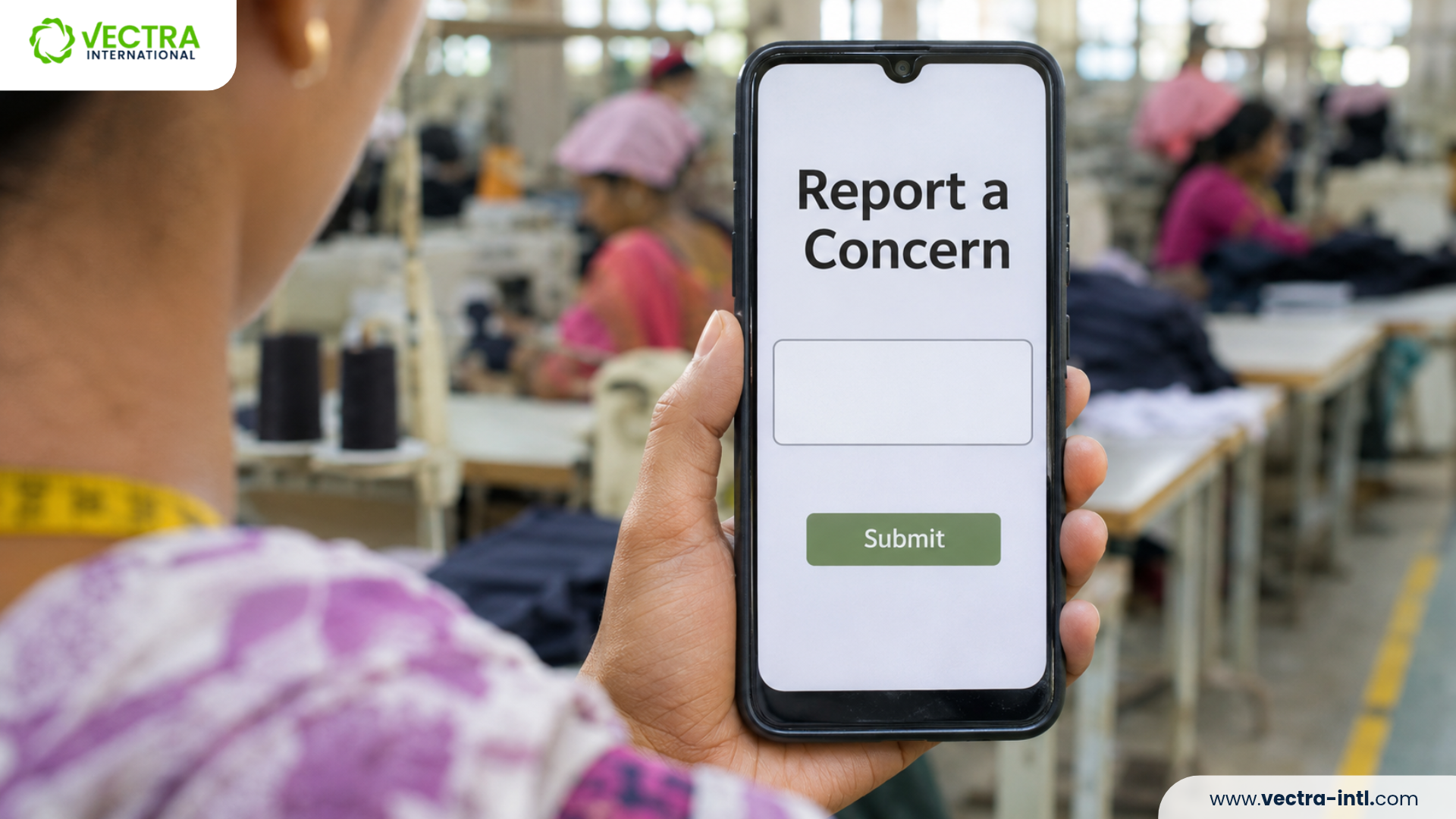
When a factory worker reports a problem, the first job is to find out whether they’re safe and how you can contact them without putting them at risk. Effective worker grievance mechanisms then give the worker an update, investigate what happened, and check that any agreed remedy reaches the people affected.
Take an illustrative example. A worker hired through a labor agency notices that six overtime hours are missing from her pay. The factory says the agency handles payroll. The agency says it paid for the hours the factory submitted. The worker can call a hotline, but the supervisor who approves her shifts also signs off on her hours. If the call goes straight back to him, she has good reason to hesitate. The case starts with a missing payment, but the first decision is how to hear from her safely.
What Should Worker Grievance Mechanisms Deliver?
A supplier can put a hotline number on the wall without deciding who will read the reports, investigate a complaint about management, or tell the worker what happened. Start the review by asking the site to explain how an actual report moves between those people. The route matters especially for agency workers: the factory may direct their work, the agency may pay them, and neither may be set up to hear a complaint about the other.
For each site, identify who runs the supplier grievance mechanism, who can investigate complaints about that person, and which workers can use it. Then check whether the routes shown in the policy work in practice. Can a night-shift worker use the channel away from the line? Can an agency worker report after an assignment ends? If the buyer does not know which agencies or subcontractors provide labor at the site, use supply chain mapping to establish who actually performs the work. Then check whether each of those groups has a route it can use.
What Should Happen When a Worker Reports a Grievance?
The person receiving the report should check for immediate harm or retaliation risk, confirm a safe way to follow up, and explain who can see the information. Give the worker a case reference if that helps them check progress, and tell them when they can expect the next update, even if the grievance investigation takes longer.
Worker grievance mechanisms give workers a way to raise concerns and seek a response. The hotline, text number, or in-person contact is the way in. Make sure agency, temporary, and subcontracted workers can use it in a language they understand, without asking a supervisor for access. Your supplier code of conduct can set that expectation, but you still need to check who can use the channel at the site.
Ask whether it’s safe to call or leave a message. A confidential report means the handler knows who reported but limits who else can see that information. An anonymous report can be made without giving a name. Either way, details such as a shift, job title, or complaint date can identify someone in a small team. Share only what the recipient needs, and explain any limits on confidentiality before passing on identifying details where possible.
In the example, the worker asks not to be called during her shift. The handler agrees on a time when she can speak privately and tells her when she’ll hear back. The first request to the factory is for the time and payroll records for the affected shift, not for the supervisor to find out who called. If the reviewer later needs to share identifying details, the handler reassesses the risk and explains the next step to the worker first where possible.
At the start of the worker grievance process, record what the worker says happened, the period involved, what they fear might happen next, and how they want to be contacted. Record allegations as allegations. A handler can acknowledge that a concern has been received without promising a particular outcome. If the next update slips, tell the worker what has delayed the review and when they should expect to hear again. Do not make the worker start the process over to find out whether anyone is acting on the report.
Which Reports Need Immediate Escalation?
Immediate danger or a credible threat of retaliation should not wait in a routine queue. Route the case to an appropriate safeguarding or specialist lead and agree on safe next contact with the worker. If emergency services or another outside route is needed, don’t make the worker wait for an internal process to finish. In the overtime example, a threat to remove the worker’s next shift changes the urgency, even before anyone verifies the missing pay.
Who Investigates a Supplier Grievance, and What Does the Buyer Do?
Worker grievance mechanisms need a case owner who can investigate without reporting to the person implicated in the complaint. The supplier or labor agency may hold the records needed to establish what happened. The buyer should agree who checks those records, when findings are due, and how to escalate if the supplier obstructs the review or cannot handle it fairly.
For the overtime report, compare the relevant shift and time records with the agency’s pay calculation and evidence of what was paid. Check whether the discrepancy affected other workers on the same shift or pay cycle. If worker interviews are needed, arrange them without the supervisor present and protect interviewees’ identities. Don’t ask the worker to collect records they can’t safely access.
The reviewer finds that the factory approved the overtime in its own timekeeping system, but the file sent to the labor agency left those hours out. The agency paid what appeared in the file. Comparing the two records shows where the hours disappeared and gives the reviewer a way to check whether others were short-paid. The reviewer updates the worker on what was found and explains what is still being checked.
What If the Factory and the Agency Give Different Answers?
Put both accounts against the same pay period and worker group. A factory time record can show that hours were approved, but it cannot show what reached the agency. The file received by the agency can show which hours it used, but it cannot show whether they were all the hours worked. A payslip shows what was calculated; a payment record and safe follow-up can show more about what the worker actually received. Ask for records that establish each handoff rather than choosing the most complete-looking file.
If one side cannot produce its record, note what remains unverified and try a proportionate alternative. In this case, the investigator could check whether the factory retained a copy of the export or whether the agency can retrieve the file it received. If the records still conflict, use a reviewer who can examine evidence from both organizations. Keep the missing evidence visible even if the team has enough to correct part of the problem.
Fair Wear’s complaints procedure shows how an outside channel can give garment workers another route when a factory process is unavailable or ineffective. For a buyer, the test is whether the investigator can examine the issue fairly and communicate with workers safely. Use supplier engagement to agree on the evidence and follow-up, and examine whether your own order changes or deadlines contributed. VECTRA’s guide to human rights due diligence for supplier impacts explains how that connection informs the response.
If a supplier says a last-minute order change drove the extra hours, ask your sourcing team to check the order history against the production schedule. In the overtime example, the export failure explains the missing pay. The buyer may still need to investigate what caused unusually heavy overtime if other records or worker accounts point that way. A change to the payroll file will not resolve a problem created by an unrealistic production schedule.
How Do You Verify the Remedy Before Closing the Case?
Before closing a grievance, tell the worker what the review found and what action was taken, as far as you can safely disclose. Where harm is confirmed, check that the agreed remedy reached the people affected. Record unresolved points, explain how the worker can challenge the outcome, and check for retaliation or recurrence.
What Changed for the Worker?
In the example, the agency issues a correction and pays the missing overtime to the worker and the others affected. The case owner checks the payment record against the corrected payslip and follows up through the contact route the worker chose. She confirms that the payment arrived. The factory assigns someone to compare approved hours with the file sent to the agency before payroll closes. At the next pay cycle, the reviewer checks the same handoff and finds that the approved hours were carried through correctly.
The file needs to distinguish what was paid, what process changed, and what the follow-up actually verified. If the corrected pay had not reached the worker, or if the same hours went missing in the next cycle, a revised payslip or a written promise would not justify marking the relevant action as complete. The OECD’s Due Diligence Guidance for Responsible Business Conduct distinguishes acting on harm from tracking whether the response worked. It also calls for companies to provide or cooperate in remediation when they caused or contributed to the harm.
When a finding is inconclusive, tell the worker what could and couldn’t be established and how they can provide more information or request a review. If the worker can’t safely be reached, record that limit. Don’t report their silence as acceptance or use a supplier audit report as a substitute for checking the outcome of this case.
What Should the Closure Record Show?
Ask the reviewer to separate the finding, the remedy for the worker, and the action to prevent the error from recurring. Those can have different owners and completion dates. If the worker has been paid but the next payroll has not run, the payment can be recorded as verified while the check on the new process stays open.
• Finding: What happened, which workers or pay periods were checked, and what evidence supports the result?
• Remedy: What was owed, what was delivered, and what evidence shows it reached the people affected?
• Prevention: Which part of the process changed, who owns it, and when will someone check it under normal operating conditions?
• Worker follow-up: What was communicated safely, what remains disputed, and who will handle any request for review or report of retaliation?
In the overtime example, the reviewer keeps the pay correction and reconciliation check under the same case reference but records the result of each separately. The worker does not wait until the next payroll to learn that her pay was corrected. The buyer sees that repayment has been verified and knows when it can expect evidence on the new control. The shared record does not need the worker’s identity to make either decision.
Worker grievance mechanisms should also give workers a way to reopen a case. Tell the worker who to contact if the payment does not arrive, the issue recurs, or they experience retaliation. That should not require a new report to the person they originally raised a concern about.
A Real Case: How Fair Wear Checked Delayed Overtime Pay
In March 2019, a garment factory worker in Myanmar reported delayed overtime payments through Fair Wear. According to Takko Fashion’s published account of complaint 617, workers had waited six weeks on one occasion. Fair Wear notified Takko, which sourced from the factory, and Takko contacted factory management.
The factory reported that it had paid the compensation and shared proof of payment with Takko, which passed it on to Fair Wear. Fair Wear then contacted the person who filed the complaint, who confirmed that the compensation had been received. The case was marked resolved in April. Fair Wear also advised Takko to work with the factory to reduce overtime. The report documents payment confirmation, but it doesn’t establish that the wider overtime problem stopped recurring.
For your next supplier review, make the same distinction. Ask for evidence that the remedy reached the people affected and, separately, what someone checked later to see whether the underlying problem returned using worker grievance mechanisms.
How Can a Buyer Tell Whether Worker Grievance Mechanisms Are Working?
Check whether workers know how to report, whether they get updates when promised, and whether verified remedies hold up after closure. Look at how the process works for people employed through agencies or subcontractors, not just permanent staff. A low complaint count is a reason to check access, not proof that there are no problems.
The International Labour Organization’s guidance on grievance handling describes a workplace mechanism as a route for workers to raise a complaint and seek a resolution. A case log tells you which factory worker complaints were recorded. To see whether workers can use the process and get a response, make a few checks outside the log:
• Ask workers privately whether they could report without a supervisor’s permission and whether they would trust the response.
• Compare promised update dates with actual updates. Look for cases that stalled, and find out who had authority to move them forward.
• Check repeat complaints, missed remedies, and reported retaliation. Feed recurring issues into your supplier risk assessment without moving names or identifying case details into shared dashboards.
Assign someone to handle grievance follow-up after the decision and agree on a safe way to contact the worker. In the overtime example, the case owner can ask whether the worker’s shifts changed unexpectedly after the report. A scheduling change is not proof of retaliation, but it gives the reviewer a reason to ask further questions. Keep the worker’s contact details in the restricted case file, not the supplier team’s shared tracker.
Which Signals Should Trigger a Closer Review?
Read the number of complaints alongside evidence of who can use the channel. A site that starts accepting reports from agency workers may receive more complaints because people have a route they trust. A site that receives none from agency workers may have low exposure, or those workers may not know the channel exists. Check with people on different shifts and employment arrangements before drawing a conclusion.
To assess worker grievance mechanisms, pair response times with evidence that remedies reached workers. A team can close cases faster by marking them complete when the supplier submits a response. That tells you little about whether the remedy was delivered. At a supplier review, sample cases marked closed and inspect the completion evidence. Also ask why overdue cases are stuck. If both the factory and labor agency are still waiting for the other to respond, the buyer needs to appoint an escalation owner rather than ask for another status update.
Look for patterns that change what you do next. Repeated short payments at one agency justify checking other sites that use its payroll process. Repeated reports about one supervisor may call for an independent review even when no individual case has yet established a finding. Record the pattern and the review decision without circulating names or assuming the allegations have been proven.
Frequently Asked Questions
Should Worker Grievance Mechanisms Require Supervisor Approval?
No. Workers need a safe route without supervisor approval, such as a trained contact outside line management, a worker representative where appropriate, or an independent channel. Check that the agency and temporary workers know about the route and can use it.
What Should a Worker Hear Back After Reporting a Grievance?
Tell them the report was received, what happens next, and when you’ll update them. At the end, explain the outcome, what action the handler can safely disclose, and how to ask for a review if the issue is still unresolved.
Should a Buyer Investigate Every Supplier Complaint?
No. A supplier can review a routine complaint if it has the records, a competent case owner, and a process the worker can use safely. A buyer should seek a different route when the supplier lacks independence, withholds information, or cannot protect the worker, and should examine its own role when its purchasing decisions may have contributed to the harm.
Does Using the Factory Process Stop a Worker From Going Elsewhere?
It shouldn’t. The commentary to Principle 29 of the United Nations Guiding Principles on Business and Human Rights explains that company-level mechanisms should not block access to courts or other grievance routes, undermine legitimate trade unions, or replace collective bargaining.
View Related Posts
• Human Rights Due Diligence: How to Assess and Prioritize Supplier Impacts
• Supplier Code of Conduct: 7 Steps From Policy to Practice
• Supplier Engagement: How to Get Better Evidence and Close Risk Gaps
VECTRA International is a trusted Business Resilience & Operational Capability Building Partner. Through our ecosystem of integrated solutions, we help organizations transform operational complexity into resilient performance, measurable business impact, and sustainable growth.
Chaussée de Wavre 1517B, 1160 Brussels, Belgium.
A Note on Our Visuals: At VECTRA, we combine human expertise with advanced technology. Some of the supportive imagery in this article was generated using artificial intelligence tools like Google Gemini. We ensure all conceptual AI assets align with our brand standards and accurately reflect our data.