ESRS reporting may apply to a non-EU group from financial year 2028 when it exceeds the EU turnover threshold and has a qualifying EU subsidiary or branch. The ESRS-40a standard is still an exposure draft, so companies should confirm scope now, map likely impact data, and avoid treating the consultation text as final law.
The immediate task is not to build a full report around a proposal. It is to determine whether your group is plausibly in scope, identify which entities would publish the report, test whether the proposed global and EU-related reporting boundaries are workable, and document the questions that need legal or technical confirmation.
What Is ESRS-40a Reporting?
ESRS-40a is the proposed European Sustainability Reporting Standard for certain undertakings governed by the law of a country outside the European Union. It is being developed under Article 40a of the EU Accounting Directive for large non-EU groups with significant EU activity.
EFRAG, an independent private association established in 2001 to advise the European Commission on corporate reporting standards ,published the ESRS-40a exposure draft and consultation materials on 23 July 2026. The consultation closes on 31 October 2026. EFRAG plans to use the feedback to finalize its technical advice to the European Commission, which is expected in January 2027. The Commission will then follow its own process before adopting a delegated act.
That sequence matters. The exposure draft is a credible basis for readiness planning, but it is not the final standard. Any implementation decision should identify which points come from the Accounting Directive, which come from EFRAG’s current proposal, and which remain subject to change.
VECTRA’s guide to ESG gap analysis and pre-audit remediation planning uses the same discipline: establish the requirement, record the current evidence, distinguish confirmed gaps from open interpretations, and assign a proportionate next action.
Who Is Expected to Be in Scope of ESRS Reporting Under Article 40a?
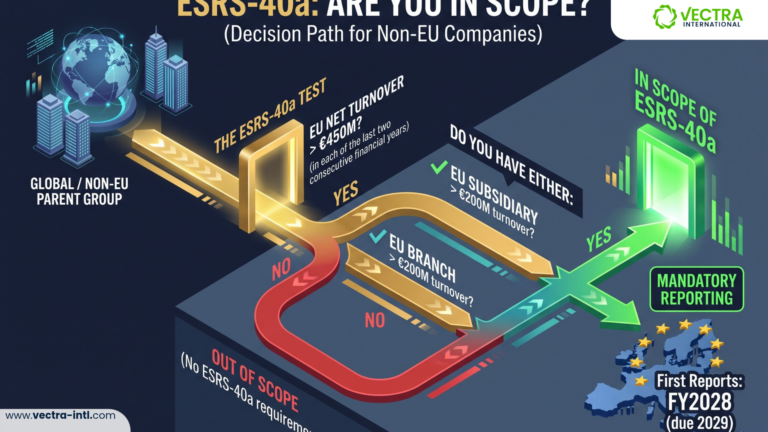
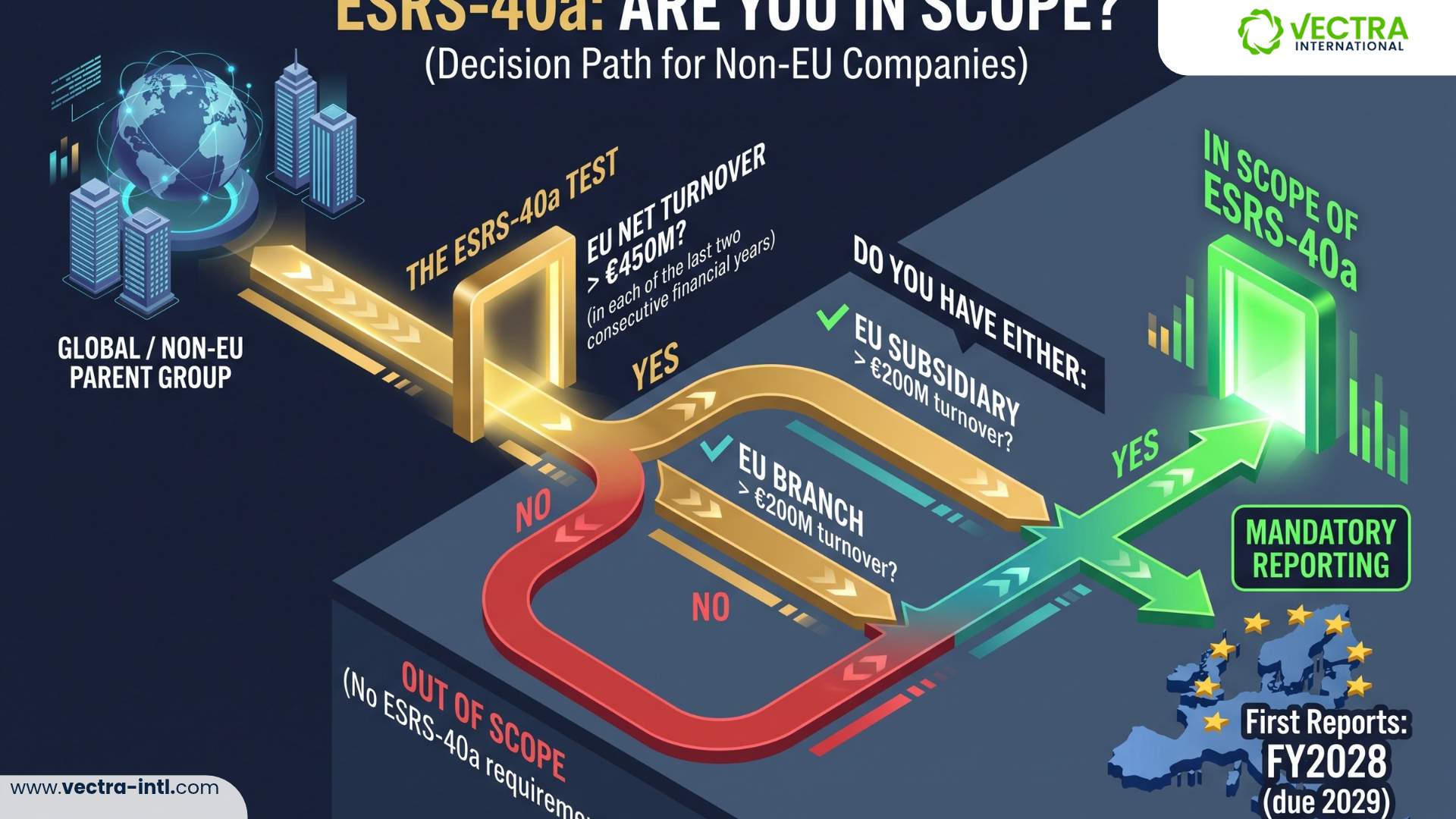
EFRAG’s current project page states that, following the Omnibus amendments, Article 40a applies when a non-EU undertaking meets both parts of the scope test.
The undertaking must:
• generate more than EUR 450 million in net turnover in the EU in each of the last two consecutive financial years; and
• either have an EU branch generating more than EUR 200 million or be the ultimate parent of EU subsidiaries generating more than EUR 200 million.
This is a group and entity analysis, not a brand-level estimate. You need to confirm the ultimate parent, the legal entities included in the group, the turnover generated in the EU, the relevant periods, and the EU subsidiary or branch condition. Currency conversion, changes in group structure, acquisitions, disposals, and the interpretation of turnover should be documented rather than resolved through an informal spreadsheet assumption.
The EU subsidiary or branch would be responsible for publishing and making the sustainability report accessible under the applicable national implementation arrangements. The report would cover the non-EU parent group at the required level, not only the local EU entity that publishes it.
If your conclusion is close to a threshold or depends on a complex structure, obtain legal advice. A content guide can explain the framework, but it cannot determine the legal scope of a specific group.
What Does the ESRS-40a Exposure Draft Propose?
EFRAG says the exposure draft retains the overall 12-standard architecture of ESRS while adapting it for third-country undertakings. The proposed model focuses on the undertaking’s impacts on people and the environment. It removes disclosures centered on financial risks, opportunities, resilience, and dependencies that form part of the wider ESRS model for EU undertakings.
The consultation asks stakeholders to consider four practical issues:
• whether the deletions and additions from the wider ESRS architecture are appropriate;
• how companies outside the EU would apply concepts and terms based on EU law;
• whether the proposed global and EU-related reporting approach is workable; and
• how ESRS-40a can operate alongside jurisdictional standards based on IFRS Sustainability Disclosure Standards.
The proposed reporting boundary is especially important. EFRAG explains that ESRS-40a would generally cover global impacts. For topics other than climate, a reporting group may be able to limit information to impacts connected with the EU under the proposed mixed approach. That choice would affect data ownership, systems, consolidation, controls, estimates, and the evidence retained to support the boundary.
Organizations already reporting under other frameworks should avoid building a separate ESRS-40a data universe. VECTRA’s article on reducing ESG data fatigue across reporting frameworks explains why common definitions, controls, and source records should support multiple reporting outputs where the requirements genuinely align.
The 7 Questions to Test ESRS-40a Scope and Readiness
These questions turn the current proposal into a controlled assessment. They do not replace legal analysis or the final standard.
1. Which Non-EU Undertaking Is the Reporting Group?
Start by identifying the ultimate non-EU parent and the group perimeter that may be covered. Do not begin with the EU subsidiary that happens to own the reporting project.
Record:
• the ultimate parent and governing law;
• the consolidation perimeter used for financial reporting;
• EU subsidiaries, branches, and recent structural changes;
• joint arrangements or controlled entities that may require interpretation;
• the proposed reporting level; and
• the legal and finance owners responsible for confirming the conclusion.
The scope record should show the source documents used, the period covered, the reviewer, and any limitations. If the legal structure changes before 2028, the assessment needs an event-based review rather than waiting for the next annual cycle.
2. Does EU Turnover Exceed EUR 450 Million for Two Consecutive Years?
Calculate EU net turnover for the same group and on a consistent basis for each of the last two consecutive financial years. Reconcile the result to controlled financial information.
A screenshot of a management dashboard is weak evidence if the underlying definition, data source, adjustments, and approval cannot be reconstructed. The scope file should allow a competent reviewer to repeat the calculation.
3. Is the EU Subsidiary or Branch Condition Met?
After the EU turnover test, confirm whether the group has a qualifying EU presence. EFRAG’s summary identifies two routes: an EU branch generating more than EUR 200 million or EU subsidiaries generating more than EUR 200 million under the ultimate parent condition.
Map every relevant EU subsidiary and branch, the turnover measure used, the applicable period, and the entity expected to publish. Where several EU entities could be involved, clarify national responsibilities, ownership, governance, language, publication, and assurance arrangements early.
This step should end with a legal-entity decision, not a general statement that the group has substantial EU operations.
4. Which Impacts Would Be Reported Globally and Which Could Be EU-Related?
The proposed mixed approach creates a design decision with significant data consequences. Climate reporting would remain global under EFRAG’s current explanation. For other topics, the group may be able to limit disclosures to EU-related impacts.
This is not merely a reporting-system setting. It depends on how the company understands its value chain and impacts. VECTRA’s review of double materiality lessons from the first wave of CSRD reports provides useful context on evidence, stakeholder perspectives, and the need to connect assessment conclusions with the disclosures that follow.
5. Which Existing Data and Controls Can Be Reused?
Map the proposed disclosure requirements to data already collected for group reporting, legal compliance, enterprise systems, customer requests, voluntary reporting, and local obligations. Reuse only when the definition, boundary, period, unit, method, owner, and evidence are compatible.
VECTRA’s explanation of the VSME value-chain cap and supplier data burden reinforces a useful principle: ask for information because a defined requirement or decision needs it, not because a broad template contains a field.
6. Can the Company Produce Evidence That Can Be Reviewed and Assured?
Article 40a reporting is expected to require an assurance opinion. Readiness therefore depends on control quality, not only data availability..
Do not wait until the first reporting year to discover that narrative claims have no source, local systems use different definitions, or supplier estimates cannot be reproduced. VECTRA’s Reporting service supports framework alignment, materiality, stakeholder engagement, gap analysis, data collection, and performance monitoring. Where evidence needs readiness testing before external review, Pre and Post Audit Assistance provides a separate route for testing gaps, corrective actions, and retained evidence.
7. What Should Be Done Before the Standard Is Final?
Act on no-regret controls and defer decisions that depend on unsettled text. A proportionate readiness plan should separate three categories.
Proceed now with:
• legal-entity and turnover mapping;
• ownership and governance;
• data inventory and definition control;
• source-to-disclosure traceability;
• impact and stakeholder mapping; and
• identification of material systems and evidence gaps.
Monitor or test before committing to:
• the final disclosure list;
• the exact mixed-boundary method;
• detailed presentation requirements;
• final interoperability decisions; and
• implementation choices that would be expensive to reverse.
Escalate for legal or technical advice when:
• the group is close to a threshold;
• the publishing entity is unclear;
• turnover treatment is disputed;
• global and EU-related impacts cannot be separated reliably; or
• local law creates an additional or conflicting requirement.
This approach prevents two opposite errors: doing nothing until the delegated act is final, or spending heavily to implement an exposure draft as though no change were possible.
ESRS-40a Readiness Decision Table
| Question | Minimum evidence | Decision if confirmed | Decision if uncertain |
| Non-EU parent and group perimeter | legal structure, consolidation records, entity list | approve reporting perimeter for planning | obtain legal and finance review |
| EUR 450 million EU turnover test | two-year calculation reconciled to controlled financial data | proceed to EU presence test | document interpretation and recalculate |
| EUR 200 million EU presence test | subsidiary or branch calculation and publishing-entity analysis | establish local governance and publication route | obtain Member State and legal advice |
| Reporting boundary | impact map and method for global or EU-related inclusion | design data collection around approved boundary | pilot the method and record exclusions |
| Data reuse | requirement-to-data map, definitions, owners, controls | reuse controlled sources | remediate definitions, ownership, or evidence |
| Assurance readiness | source trail, review evidence, change control | include in reporting dry run | assign control improvements before reporting |
| Final-text dependency | decision log separating confirmed and proposed requirements | proceed with no-regret action | monitor EFRAG and Commission developments |
Start With the Scope File, Not the Reporting Template
Your first deliverable should be a controlled scope file that identifies the reporting group, calculates the thresholds, names the publishing route, records the proposed boundary, and distinguishes confirmed requirements from consultation proposals. That file gives every later workstream a defensible starting point.
If your group appears to be in scope, VECTRA can help translate the emerging requirements into a practical reporting and evidence plan through its Reporting service. The aim is not to predict every final datapoint. It is to build the ownership, definitions, traceability, and review controls that will remain useful when the standard is finalized.
Summary
Who
The future requirement is aimed at certain non-EU undertakings with significant EU activity. Legal, finance, sustainability, reporting, internal control, data, and assurance teams will need a shared scope conclusion and operating plan.
What
ESRS-40a is a proposed sustainability reporting standard focused on the impacts of large non-EU groups on people and the environment. The current exposure draft retains the 12-standard ESRS architecture but adapts the content and reporting boundary for Article 40a.
When
The EFRAG consultation closes on 31 October 2026. The cost-benefit survey closes on 11 October 2026. The first reports are expected to cover the financial year 2028 and be published in 2029, subject to the final legal process.
Where
The requirement is triggered by significant EU activity, while the proposed report generally covers impacts across the non-EU parent group. The mixed approach may allow EU-related limits for certain non-climate topics.
Why
The policy objective is to improve transparency about the impacts of the largest non-EU groups active in the EU and support a level playing field. For companies, early scope and control work reduces the risk of late boundary disputes, duplicated data requests, and evidence that cannot withstand review.
Frequently Asked Questions
Is ESRS-40a final?
No. EFRAG published an exposure draft for consultation. Feedback will inform its technical advice to the European Commission. The Commission must then complete its own process before adopting the standard through a delegated act.
When does ESRS reporting start for non-EU companies under Article 40a?
EFRAG states that reporting under the future ESRS-40a will apply for financial years beginning on or after 1 January 2028. The first sustainability reports are therefore expected to be published in 2029.
What are the proposed Article 40a thresholds?
EFRAG’s current summary states that the non-EU undertaking must generate more than EUR 450 million in EU net turnover in each of the last two consecutive financial years and must either have an EU branch generating more than EUR 200 million or be the ultimate parent of EU subsidiaries generating more than EUR 200 million.
Does ESRS-40a use double materiality?
The exposure draft focuses on impacts on people and the environment. EFRAG says it removes disclosures on risks, opportunities, resilience, and dependencies from the wider ESRS model. Companies should review the final standard before setting the permanent assessment method.
Can a company report only EU impacts?
The exposure draft proposes a mixed approach. Climate information would remain global, while a group may be able to limit certain other disclosures to EU-related impacts. The method and evidence for applying that option should be tested carefully.
Should a company start collecting every proposed datapoint now?
No. Start with scope, boundaries, ownership, data inventory, and evidence controls. Use a limited dry run to test the system, then expand when the final requirements are clearer.
Related Posts
• How to Make ESG and Climate Reporting Easier
• FMCG Sustainability Data: How to Collect Evidence Procurement Can Use
• Independent Assurance vs. Internal Audit: Avoid the Wrong Review
VECTRA International is a trusted Business Resilience & Operational Capability Building Partner. Through our ecosystem of integrated solutions, we help organizations transform operational complexity into resilient performance, measurable business impact, and sustainable growth.
Chaussée de Wavre 1517B, 1160 Brussels, Belgium.
A Note on Our Visuals: At VECTRA, we combine human expertise with advanced technology. Some of the supportive imagery in this article was generated using artificial intelligence tools like Google Gemini. We ensure all conceptual AI assets align with our brand standards and accurately reflect our data.