Digital compliance transformation doesn’t start with software. It starts with one compliance workflow, shared data definitions, clear owners, and an evidence trail you can defend. Then you automate the repetitive steps while keeping judgment, exceptions, and remediation under human control.
That matters if your team is capable but stretched. You may already have approved policies and several systems. The friction sits between them: duplicate supplier records, different risk ratings, approvals buried in email, evidence stored in personal folders, and no single view of overdue actions.
VECTRA’s article on technology in supply chain due diligence covers the tools that can support visibility and monitoring. This article addresses the next question: how do you redesign the operating process so those tools produce controlled, defensible decisions?
Why Spreadsheets Break Digital Compliance Workflows
Spreadsheets aren’t the enemy. They’re familiar, flexible, and quick to start. The trouble begins when your process depends on people remembering which version is current, who must act next, what evidence supports a status, and when an exception needs escalation.
The cost is not limited to administration. PwC’s Global Compliance Survey 2025 found that 77% of respondents said compliance complexity had negatively affected their companies. Better coordination mattered: 59% reported greater confidence in compliance decisions because of it. Technology helped with visibility, faster issue identification, reporting, and productivity, but data remained the constraint. 63% said complex and disaggregated data made compliance more difficult.
That’s why buying software can leave the underlying problem intact. If two teams define an active supplier differently, a new dashboard will display the disagreement faster. If no one owns an expired certificate, an alert only creates a more visible orphaned task.
Compliance Digitization vs. Digital Compliance Transformation
Digitization turns paper or local files into searchable data. It improves access but may preserve the same fragmented process.
Automation moves a defined task without manual prompting. It can route a questionnaire, send an expiry reminder, or assemble an evidence pack. Automation is valuable only when the rule, data, and exception path are clear.
Transformation changes the operating model. Obligations connect to controls. Controls connect to owners, evidence, review dates, and decisions. Teams use the same definitions. Exceptions move to the right authority. Management sees risk and performance without rebuilding the answer each month.
A good target is controlled flow, not maximum automation. The process should move routine work quickly and slow down where judgment is needed.
Five Signs Your Compliance Process Is Not Ready to Automate
1. The same data means different things. Procurement counts vendors, finance counts payees, and compliance counts legal entities, but the records are treated as one population.
2. Status is not tied to evidence. A row says approved, low risk, or complete, but nobody can see the record, criteria, reviewer, or date behind it.
3. Ownership changes by memory. Teams know who usually handles a task, yet there is no rule for absence, escalation, or reassignment.
4. Exceptions live outside the workflow. The easy cases are tracked, while the cases that matter most move into email, chat, or private meetings.
5. Success is measured by activity. The program reports questionnaires sent or alerts closed, not control coverage, time to decision, repeat issues, or overdue risk.
If three or more of these signs are present, pause the technology configuration. Map and standardize one workflow first. That is usually faster than correcting a poorly configured system after adoption stalls.
Standardize the Compliance Control Before You Automate It
For one workflow, define the minimum control design on a single page. Name the trigger, required data, decision rule, owner, reviewer, evidence, exception route, service level, and retention period. Keep the language close to the work. Your procurement manager should be able to run it without translating a policy document.
Then agree on the data dictionary. Decide what a supplier, site, certificate, obligation, risk rating, finding, and closed action mean. Assign a source of truth for each field. Record the identifier that connects the same entity across procurement, finance, quality, and compliance systems.
Where Automation Ends and Human Judgment Begins
| Workflow point | Standardize first | Good automation candidate | Human decision |
| Supplier intake | Required fields, entity ID, risk triggers | Validation, duplicate check, routing | Approve missing data or special onboarding |
| Screening and review | Lists, cadence, match criteria, evidence | Scheduled checks, alerts, case creation | Resolve possible matches and materiality |
| Document expiry | Document type, validity rule, owner | Reminders, supplier request, escalation | Accept an alternative or pause the supplier |
| Issue remediation | Severity, due date, proof of closure | Tasks, reminders, dashboards | Judge adequacy and residual risk |
| Reporting | Metric definitions and data cut-off | Aggregation and evidence pack | Interpret trends and set action |
What to Automate First
Start with work that is frequent, rules-based, measurable, and expensive to coordinate manually. Good first candidates include data validation, duplicate detection, risk-based routing, recurring screening, document expiry reminders, evidence requests, approval sequencing, overdue escalation, and management reporting.
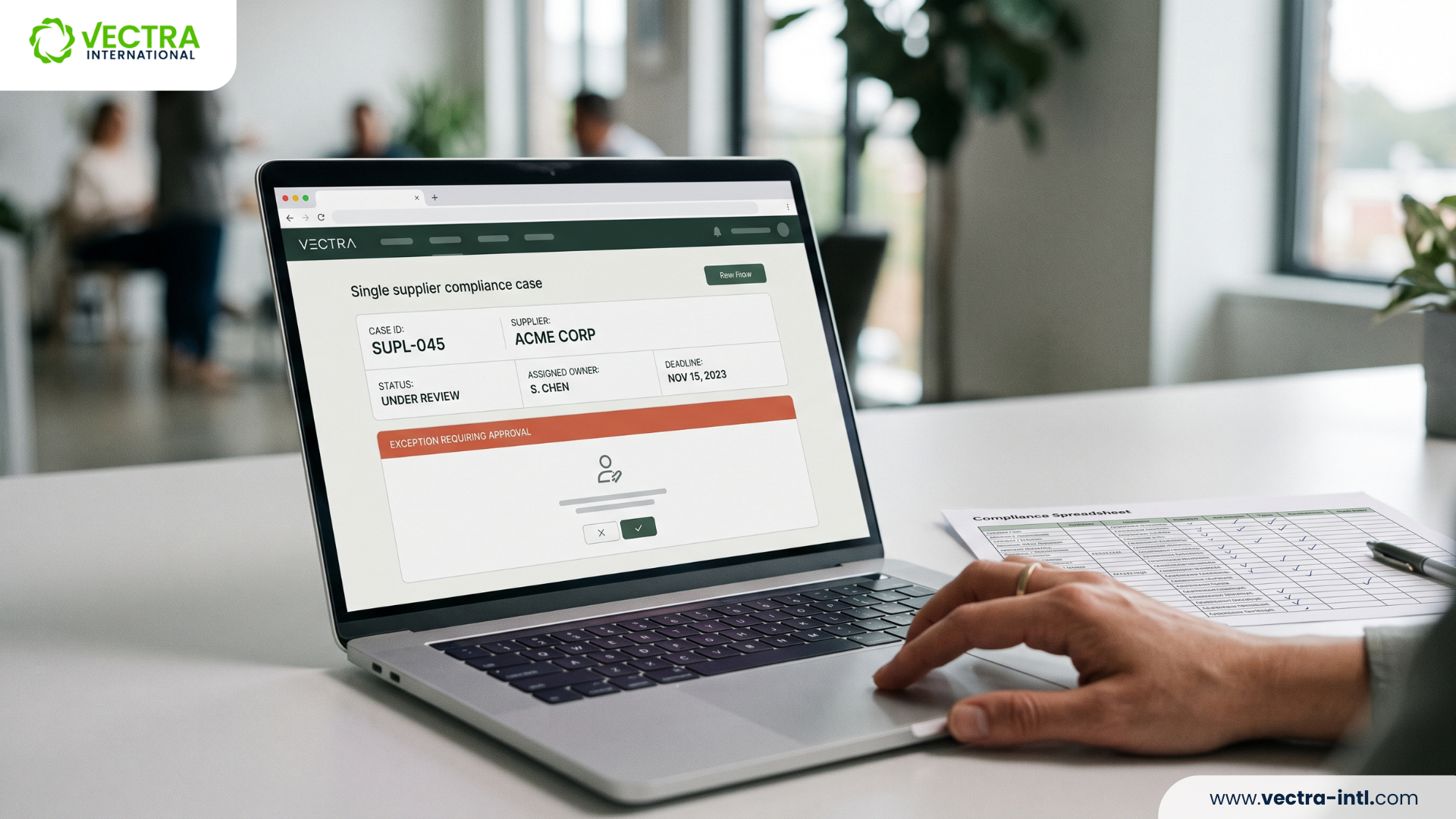
Automation should create an audit trail as it works. Each action needs a timestamp, actor, input, output, and link to the underlying record. If a rule changes, preserve the version that applied to an earlier decision. This matters when a customer, regulator, or auditor asks not only what the current process is, but why a specific supplier or transaction was approved at the time.
Use monitoring to reopen the workflow when facts change. VECTRA’s guide to moving risk monitoring from periodic to continuous shows how event-driven signals can support this shift. The control design still needs to decide which signal creates a task, who reviews it, and what counts as closure.
What Must Stay Under Human Control
Keep people accountable for legal interpretation, materiality, ambiguous matches, supplier explanations, remediation quality, conflicts between commercial and compliance priorities, and the acceptance of residual risk. These decisions depend on context and often affect rights, relationships, or market access.
AI can summarize records, propose classifications, or identify unusual patterns. It should not quietly become the decision owner. The NIST AI Risk Management Framework Playbook organizes AI risk work around Govern, Map, Measure, and Manage. For compliance teams, that translates into documented purpose, defined oversight, tested performance, and a clear route for challenge or correction.
A practical rule is to automate movement and preparation before automating judgment. Let the system collect, validate, compare, remind, and package. Let an authorized person decide when the facts are incomplete, the rule is disputed, or the impact is significant.
How to Pilot Digital Compliance Transformation in One Workflow
Choose a workflow that has visible pain, repeatable volume, and a contained risk boundary. Supplier document renewal, conflict-minerals declarations, corrective-action follow-up, or regulatory obligation assignment can work well. Avoid a first pilot that requires every function and every country to redesign at once.
- Map the current flow. Follow five real cases from trigger to closure and record every handoff, duplicate entry, delay, exception, and evidence location.
- Define the target control. Agree on the decision rule, data, owners, evidence, service levels, exceptions, and reporting before configuration.
- Clean the minimum data. Correct the population and identifiers needed for the pilot. Do not postpone ownership of bad data to the software.
- Configure and test edge cases. Test missing data, expired evidence, conflicting records, false-positive matches, supplier non-response, and approver absence.
- Run in a controlled period. Use a defined cohort, provide role-based training, and compare results with the prior process.
- Scale only after the control is stable. Fix rule and ownership failures first. Then add suppliers, regions, or related workflows.
This staged approach aligns with Thomson Reuters’ 2025 guidance for corporate functions, which emphasizes a defined strategy, targeted early initiatives, and KPIs. Its research found that only 19% of respondents had an AI strategy, while organizations with a well-defined strategy were almost four times as likely to report benefits.
Set Governance Before the Pilot Becomes a Program
Name a control owner, a process owner, a data owner, and a system owner. The control owner decides what must be achieved. The process owner makes the workflow usable. The data owner protects definitions and quality. The system owner manages configuration, access, and change. In a smaller company, one person may hold more than one role, but the responsibilities should still be explicit.
Use a simple change process. A new rule, data field, risk threshold, or AI feature should have a business reason, an approver, a test record, an effective date, and a rollback plan. This prevents well-intended configuration changes from weakening evidence or creating a second version of the process.
Measure Control Performance, Not Software Activity
A transformed process should improve decisions and reduce exposure. Track the percentage of in-scope records with complete evidence, time from trigger to decision, overdue high-risk actions, exception age, repeat findings, false-positive rate, supplier response time, manual touches per case, and time required to assemble an audit-ready file.
Add one adoption measure: whether the work is actually completed inside the controlled workflow. Low usage may indicate training needs, but it may also reveal that the process is slower, the data requirement is unrealistic, or the exception route is missing. Treat workarounds as design evidence, not employee failure.
Management reporting should show three things: where risk is concentrated, whether the control is operating on time, and which decisions need leadership. A colorful dashboard that cannot answer those questions is presentation, not control.
Build a Digital Compliance Process You Can Defend
VECTRA helps organizations standardize due diligence workflows, clarify ownership, improve data and evidence, and introduce technology in practical stages. Book a free consultation to choose a pilot workflow and define the control before configuration begins.
Digital Compliance Transformation FAQs
What is digital compliance transformation?
It is the redesign of compliance work so obligations, controls, tasks, evidence, exceptions, and decisions move through a connected process. Technology supports the model, but the transformation comes from shared definitions, ownership, and measurable control performance.
Should a company replace all compliance spreadsheets?
No. Keep spreadsheets where the work is limited, controlled, and easy to review. Replace or connect them when version control, scale, handoffs, evidence, security, or recurring exceptions make the process unreliable.
Which compliance workflow should be automated first?
Choose a frequent, rules-based workflow with clear pain and a contained risk boundary. Document renewal, recurring screening, corrective-action follow-up, and evidence collection are common candidates.
Where should humans remain involved?
People should own legal interpretation, ambiguous matches, materiality, supplier engagement, remediation quality, exceptions, and residual-risk acceptance. Automation should prepare and route those decisions, not hide them.
How long should a pilot take?
A focused pilot can often be designed and tested in 8 to 12 weeks, depending on data quality, integrations, and stakeholder availability. Define a small cohort and success measures first. Scale only after the workflow produces reliable evidence and decisions.
View Related Posts
- The Role of Technology in Supply Chain Due Diligence
- How AI Agents Can Move Risk Monitoring From Periodic to Continuous
- What Is Supply Chain Due Diligence? Definition, Benefits, Solutions
VECTRA International is a trusted Business Resilience & Operational Capability Building Partner. Through our ecosystem of integrated solutions, we help organizations transform operational complexity into resilient performance, measurable business impact, and sustainable growth.
Chaussée de Wavre 1517B, 1160 Brussels, Belgium.
A Note on Our Visuals: At VECTRA, we combine human expertise with advanced technology. Some of the supportive imagery in this article was generated using artificial intelligence tools like Google Gemini. We ensure all conceptual AI assets align with our brand standards and accurately reflect our data.