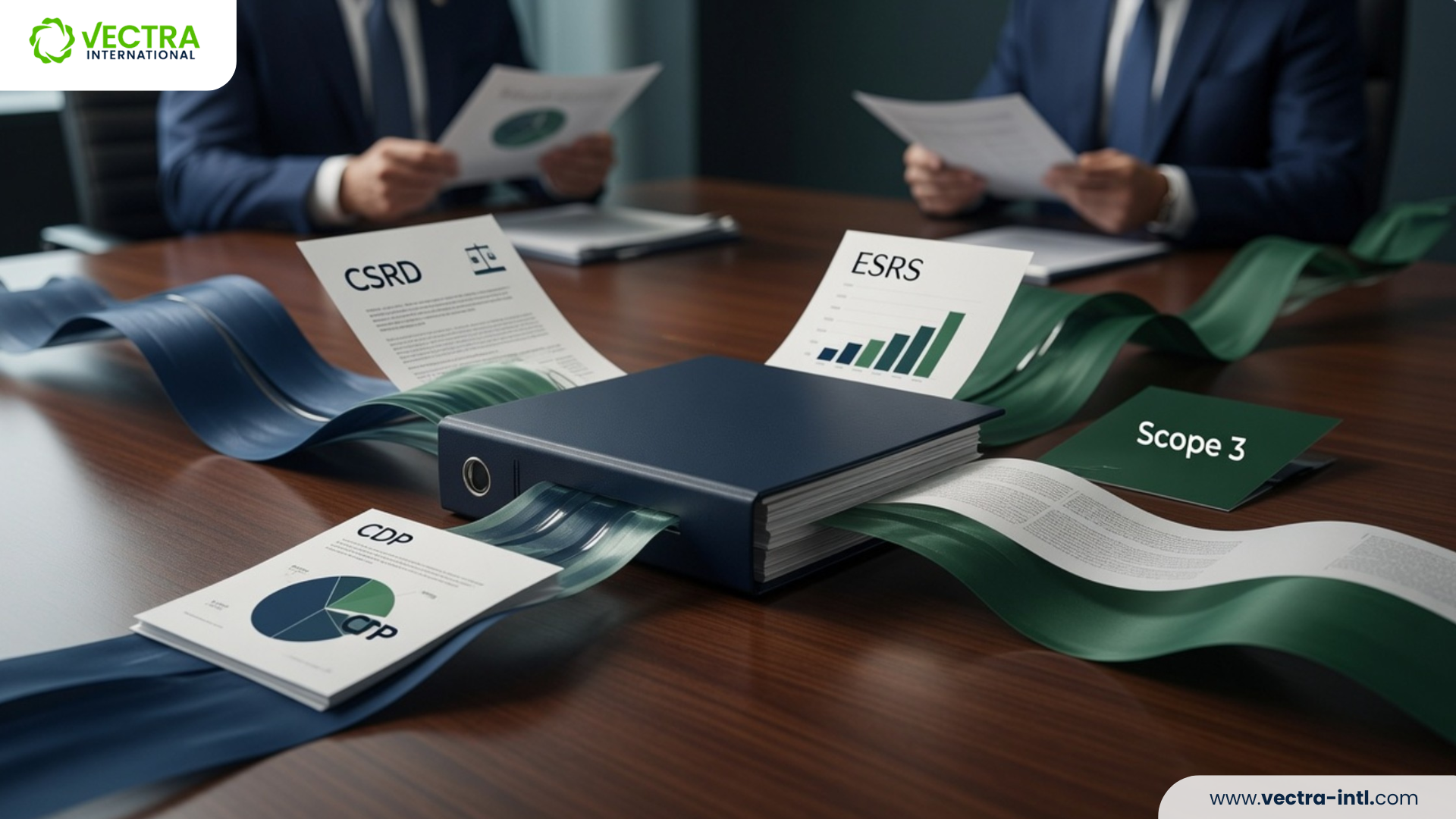
As sustainability regulations continue to evolve, many organizations are struggling with ESG data fatigue. Teams responsible for CSRD reporting, ESRS disclosures, CDP submissions, and Scope 3 emissions reporting are often collecting the same information multiple times for different stakeholders.
The challenge is no longer a lack of sustainability data. The challenge is managing growing volumes of ESG and climate information efficiently while meeting multiple reporting requirements.
Why ESG Data Fatigue Is Increasing
Organizations today face an expanding list of disclosure obligations, including:
- Corporate Sustainability Reporting Directive (CSRD)
- European Sustainability Reporting Standards (ESRS)
- CDP climate disclosures
- Scope 1, Scope 2, and Scope 3 emissions reporting
- Customer ESG questionnaires
- Investor sustainability reporting requests
When these requirements are managed separately, sustainability teams spend significant time gathering, validating, and reformatting the same data across different reporting frameworks.
This duplication increases compliance costs and creates a greater risk of reporting inconsistencies.
The Importance of a Unified ESG Reporting Strategy
One of the most effective ways to reduce ESG data fatigue is to create a single, unified source of sustainability data.
Rather than building separate reporting processes for CSRD, ESRS, CDP, and customer requests, organizations should establish a centralized emissions and ESG data management system.
A unified reporting strategy can help businesses:
- Improve data quality and consistency
- Reduce duplicate reporting efforts
- Simplify climate disclosure processes
- Strengthen audit readiness
- Lower compliance costs
By collecting data once and using it across multiple frameworks, organizations can significantly improve reporting efficiency.
How Double Materiality Can Reduce Reporting Complexity
Under the CSRD, companies are required to conduct a double materiality assessment. This process helps organizations identify the sustainability topics that are most relevant to their business and stakeholders.
Double materiality considers:
- The impact of sustainability issues on business performance
- The impact of business activities on people and the environment
By focusing on material topics, companies can avoid spending time and resources on non-essential data collection and reporting activities.
Recent efforts to simplify ESRS requirements have further reinforced the importance of prioritizing material disclosures rather than reporting everything.
Why Scope 3 Emissions Remain a Major Challenge
For many organizations, Scope 3 emissions account for the largest share of their carbon footprint. However, Scope 3 data often comes from suppliers, logistics providers, and other external partners, making it difficult to collect and verify.
Businesses that invest in centralized ESG data systems are better positioned to:
- Improve supplier engagement
- Enhance emissions calculations
- Support CSRD and ESRS reporting requirements
- Respond more efficiently to customer sustainability requests
As climate disclosure expectations continue to grow, improving Scope 3 emissions management will remain a critical priority.
Using Technology to Streamline ESG and Climate Disclosures
Technology is becoming essential for organizations seeking to manage ESG reporting efficiently.
Digital solutions and AI-powered reporting tools can help businesses:
- Automate data collection processes
- Reduce manual reporting workloads
- Improve reporting accuracy
- Support multi-framework compliance
- Accelerate sustainability reporting timelines
At VECTRA International, we help organizations simplify ESG and climate disclosure requirements through technology-enabled compliance solutions. Tools such as the CDP AI Partner, developed in collaboration with Reblue Ventures, demonstrate how businesses can reduce the time, complexity, and cost of global sustainability reporting.
Final Thoughts
As regulatory requirements continue to expand, organizations must find ways to reduce ESG data fatigue while improving reporting quality.
Companies that focus on double materiality, data deduplication, and a unified ESG reporting strategy will be better prepared to meet CSRD, ESRS, CDP, and climate disclosure requirements while controlling compliance costs and strengthening stakeholder confidence.
Frequently Asked Questions About ESG Data Fatigue
What is ESG data fatigue?
ESG data fatigue occurs when organizations repeatedly collect and report the same sustainability data across multiple frameworks and stakeholder requests.
Why is ESG reporting becoming more complex?
Companies must comply with multiple frameworks such as CSRD, ESRS, CDP, and Scope 3 emissions reporting, each with overlapping data requirements.
How can companies reduce ESG data fatigue?
Businesses can reduce reporting burdens by creating a unified ESG data management system and eliminating duplicate data collection processes.
What is double materiality in CSRD reporting?
Double materiality assesses both how sustainability issues affect a company and how the company impacts people and the environment.
Why are Scope 3 emissions difficult to report?
Scope 3 emissions rely on data from suppliers and external partners, making collection and verification more challenging than Scope 1 and Scope 2 emissions.
Can one data set support multiple reporting frameworks?
Yes. A centralized ESG data platform can often support CSRD, ESRS, CDP, customer questionnaires, and other climate disclosure requirements.
How can technology improve ESG reporting?
Technology can automate data collection, improve data quality, and streamline reporting across multiple sustainability frameworks.
View Related Posts
How CSRD Compliance Fails to Detect Forced Labor in Tier-2 Textile Suppliers
How Will the EUDR “Simplification Review” Redefine Your Sourcing Strategy This Month?
VECTRA International is a global expert in Supply Chain Risk & Responsibility. We positively impact businesses, their workers, and communities by helping create better, more efficient supply chain workplaces.
Chaussée de Wavre 1517B, 1160 Brussels, Belgium
A Note on Our Visuals: At VECTRA, we combine human expertise with advanced technology. Some of the supportive imagery in this article was generated using artificial intelligence tools like Google Gemini. We ensure all conceptual AI assets align with our brand standards and accurately reflect our data.