Why Companies Are Prioritizing IRMA Certification Today
The mining sector is experiencing a fundamental shift. What was once viewed as a “compliance exercise” has become a strategic business imperative. ESG performance now ranks as the top business risk in the mining industry, and investors, governments, and communities are demanding verifiable proof of responsible practices.
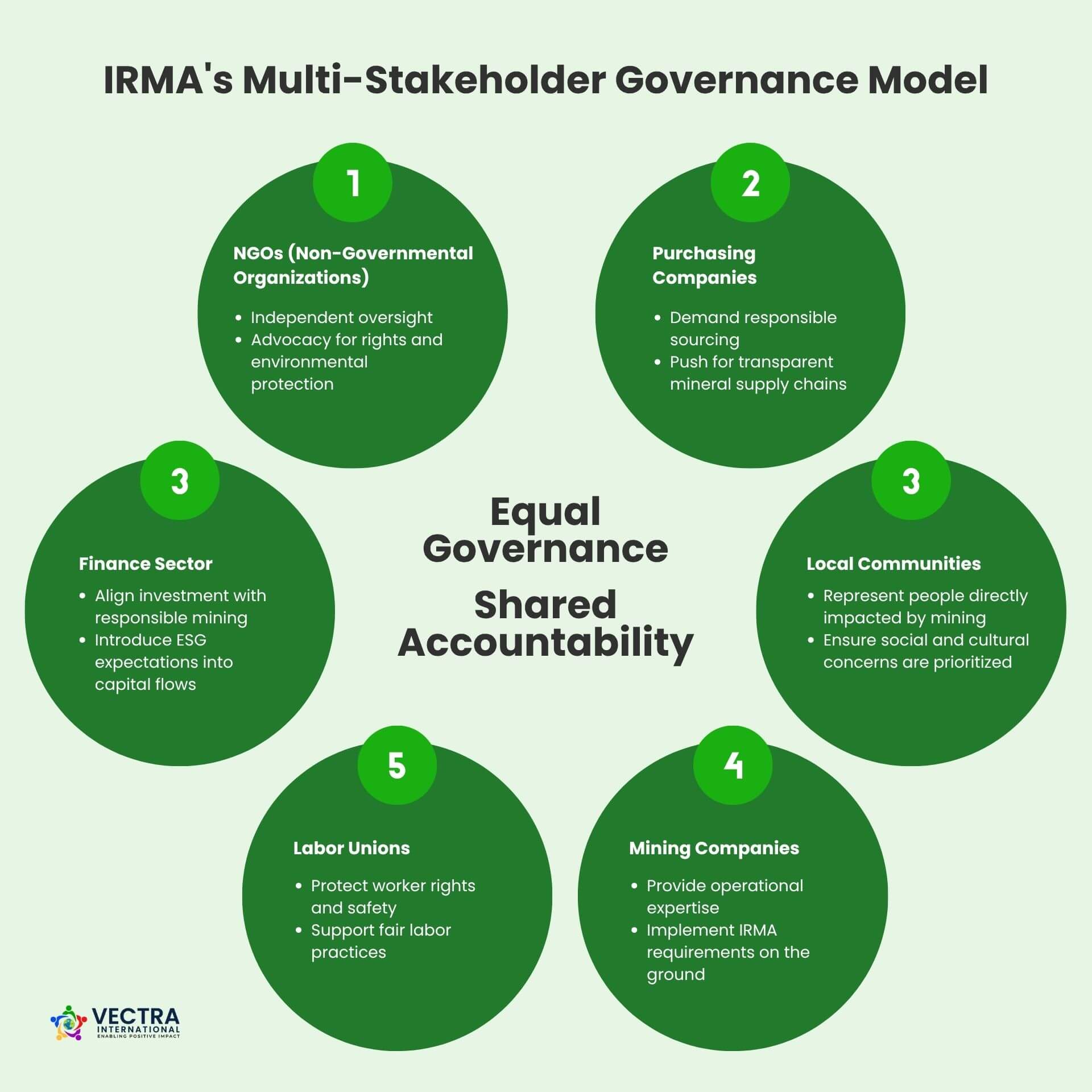
The Initiative for Responsible Mining Assurance (IRMA) offers the only independent, third-party assessment of industrial-scale mine sites for all mined materials that is governed equally by the private sector, local communities, civil society, and workers. With best practice requirements on 26 topics, IRMA represents the world’s most comprehensive and rigorous mining standard, developed through a robust multi-stakeholder process.
This guide explains everything you need to know about IRMA certification. From understanding its structure to navigating the assessment process to achieving your target performance level.
What Is IRMA?
IRMA was founded in 2006 by a coalition of six sectors: nongovernment organizations, businesses purchasing minerals and metals for resale in other products, affected communities, mining companies, and labour unions. This multi-stakeholder governance ensures that no single sector dominates the standard-setting process.
IRMA certifies a mine (not a mining company) although a mining company may have all its mines certified. IRMA’s scope is within the mining, metals, and minerals sector including all types of industrial-scale or large-scale mining. This excludes artisanal or small-scale mining and all mined materials with the exception of energy fuels.
Understanding IRMA’s Four Principles and Their Requirements
IRMA’s assessment covers over 400 requirements across human rights, air and water quality, occupational health and safety, financial security, and community contribution and investment. These requirements are organized into four main principles:
- Business Integrity – Anti-corruption, revenue transparency, community grievance mechanisms
- Planning for Positive Legacies – Mine closure planning, environmental restoration, financial assurance
- Social Responsibility – Free, prior and informed consent (FPIC), labor rights, community engagement
- Environmental Responsibility – Water management, biodiversity protection, waste management, emissions control
The Difference of IRMA From Other Standards
Unlike single-issue standards like ISO 14001 or EITI, IRMA integrates environmental, social, governance, and planning requirements into one comprehensive framework. The IRMA Standard aligns with and complements:
- EITI (Extractive Industries Transparency Initiative)
- OECD Due Diligence Guidance
- UN Guiding Principles on Business and Human Rights
- IFC Performance Standards
- ISO 14001, ISO 26000, ISO 37001
Key advantage: If you’re already working toward these frameworks, much of your compliance infrastructure likely applies to IRMA requirements.
Guide to The Four Achievement Levels
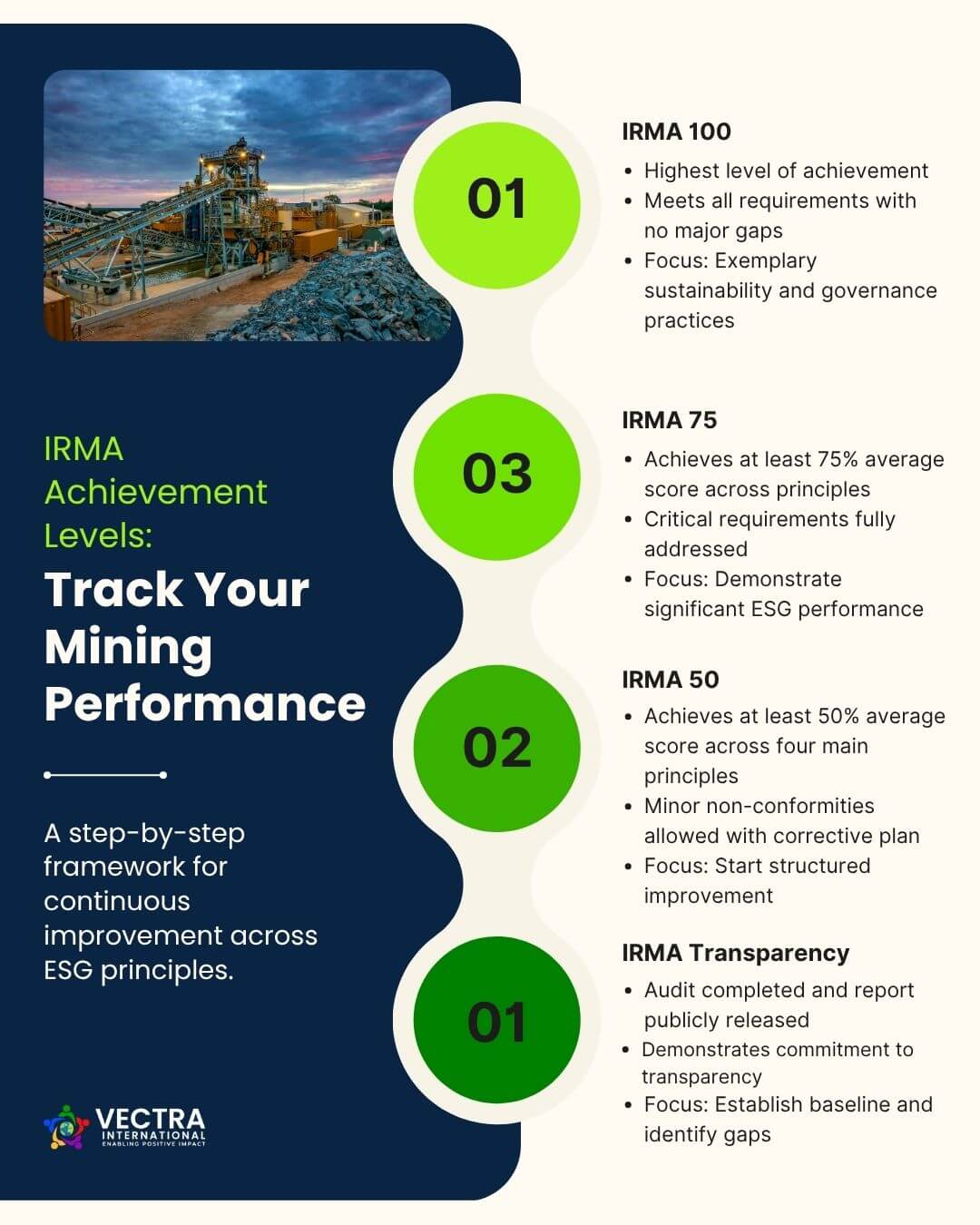
There are four achievement levels in the IRMA system:
- IRMA Transparency
- IRMA 50
- IRMA 75
- IRMA 100
reflecting increasingly higher levels of performance across the four sections of the IRMA Standard.
IRMA Transparency
IRMA Transparency is given to a mine site that is audited against the IRMA Standard, releases the subsequent audit report publicly, and doesn’t reach a higher achievement level.
What this means: Even if you don’t achieve IRMA 50 or higher, you gain credibility by demonstrating transparency and commitment to improvement.
IRMA 50, 75, and 100
IRMA 50 and IRMA 75 are achieved when a mine meets at least 50% or 75% average of the possible scores in each of the four main principles. Mines can’t score 100% in social chapters and 0% in environmental chapters and be IRMA 50; they need to achieve at least 50% average in each of the four principles.
- Critical Requirements: At the 50, 75 and 100 levels of achievement, mines must also meet a set of critical requirements, although at IRMA 50 and IRMA 75 some minor non-conformity is allowed as long as there is a corrective action plan to fully meet them by the next 3-year cycle full verification audit.
Key Takeaways:
- Progression is stepwise, not all-or-nothing
- Continuous improvement is rewarded
- Aligns with business objectives, risk management, and stakeholder expectations
Choosing Your Target Level
Your target achievement level depends on:
- Current operational maturity
- Stakeholder expectations (investors, buyers, communities)
- Resource capacity
- Timeline constraints
- Strategic business objectives
- VECTRA Tip: Many operations start at IRMA 50 and progressively work toward higher levels over subsequent assessment cycles. This phased approach allows you to demonstrate continuous improvement while managing resource allocation efficiently.
The Assessment Process of IRMA Certification
Stage 1: Self-Assessment
The self-assessment helps you:
- Identify current performance levels across 400+ requirements
- Spot documentation and evidence gaps
- Prioritize corrective actions
- Estimate readiness for formal audit
Timeline: Self-assessment typically takes 2-4 months depending on your operation’s complexity and internal coordination.
Stage 2: Desktop Review (Stage 1 Audit)
Auditors perform a document review of evidence against the IRMA Standard, known as a Stage 1 or desktop review. The output of this step is an initial, draft record of assessment scores and findings.
What happens: Auditors review policies, procedures, reports, and documentation to verify alignment with IRMA requirements before the onsite visit.
Stage 3: Onsite Audit (Stage 2 Audit)
Auditors plan a visit compatible with the schedules and safety procedures at the mine to document how the operation conforms to the IRMA Standard in practice Minsus.
Critical component: Audits include site visits and input from communities and NGOs. Stage 2 includes interviews with external stakeholders without mine personnel present which includes public officials, community services, NGOs, community members, and other interested parties.
Stage 4: Reporting and Corrective Actions
Upon mine site team approval, the report is finalized for administrative review and acceptance within the IRMA system, allowing for a certification decision. If certification is granted even though the mine has some minor nonconformities, appropriate and timely actions will be taken by the mine to correct problems and analyze issues contributing to the nonconformity.
Timeline guidance: The audit firm completes the draft report within 30 days of Stage 2, and mining operations can take up to 12 months to implement corrective actions before the report is finalized.

The Seven Most Challenging Requirements
Based on IRMA’s own analysis and industry feedback, IRMA has flagged seven particularly challenging chapters where mines struggle with interpretation and evidence.
Challenge #1: Free, Prior and Informed Consent (FPIC)
New mines shall not be certified by IRMA unless they have obtained the free, prior and informed consent of potentially affected indigenous peoples. For existing mines, operating companies must demonstrate that they are operating in a manner that seeks to achieve the objectives of this chapter, such as providing evidence of signed agreements or processes to remedy past impacts.
Common roadblocks:
- Project-affected persons are often at a disadvantage from the outset because they do not have vast financial resources at their disposal to successfully challenge proposed projects
- For large-scale projects, the number of project-affected persons can run into the thousands, and these stakeholders are rarely unanimous in their views
Business impact: Failing to establish genuine FPIC processes creates significant risk. Communities have successfully forced mine shutdowns, and the reputational damage can be substantial.
Challenge #2: Stakeholder Engagement Beyond Compliance
Meaningful stakeholder engagement goes far beyond informational meetings. It requires:
- Culturally appropriate communication methods
- Transparent benefit-sharing discussions
- Robust grievance mechanisms
- Ongoing dialogue throughout the mine lifecycle
The cost of inadequate engagement: Community conflicts represent real financial risk and not just reputational damage.
Challenge #3: Documentation and Evidence Systems
Many mines struggle not with the practices themselves, but with systematically documenting evidence across 400+ requirements. Successful operations build:
- Centralized evidence management systems
- Regular internal audits
- Cross-functional coordination between environmental, social, H&S, and compliance teams
The Business Case for IRMA
Access to Capital Markets
IRMA certification helps mines gain a competitive edge, minimize risk, fuel continuous improvement, create shared value between mines and communities, retain top talent, and increase the likelihood of profitability.
Increasingly, sustainable finance depends on demonstrable ESG performance. Investors and lenders are incorporating IRMA-level standards into due diligence processes.
Risk Mitigation
The costs of ESG failures are measurable and significant:
- Community conflicts and operational delays
- Litigation and regulatory penalties
- Investor withdrawal
- Reputational damage affecting talent acquisition and market access
IRMA provides a systematic framework for identifying and mitigating these risks before they escalate.
Market Differentiation
A growing body of evidence suggests that implementation of IRMA creates shared value between operating mines and nearby communities, provides incentives for retaining top talent, and increases the likelihood of profitability.
Preparing for Your IRMA Journey
Step 1: Conduct a Readiness Gap Assessment
Before committing to formal assessment, understand where you stand. A comprehensive gap assessment identifies:
- Requirements you’re already meeting
- Quick wins that require minimal investment
- Areas requiring significant corrective action
- Resource requirements and timelines
Step 2: Build Internal Capacity
IRMA recognizes that occasional, temporary failures of conformity are inevitable when managing large, complex mining operations. Success requires:
- Cross-functional team alignment
- Clear accountability structures
- Training on IRMA requirements
- Evidence collection protocols
This is where formal training becomes invaluable. Understanding IRMA’s structure, scoring methodology, and auditor expectations accelerates your preparation and reduces costly missteps.
Step 3: Engage Stakeholders Early
IRMA was developed with stakeholder participation in mind. Public announcements of mines currently undergoing onsite IRMA audits allow stakeholders to leave feedback for a mine currently being audited.
Don’t wait for the audit to begin stakeholder engagement. Proactive communication builds trust and demonstrates your commitment to transparency.
Step 4: Set Realistic Targets
IRMA uses a step-by-step approach, not a pass/fail certification system. Your first assessment establishes a baseline. Subsequent cycles demonstrate continuous improvement.
Strategic approach: Focus on achieving one level and building toward the next, rather than overextending resources trying to achieve IRMA 100 immediately.
Assess your procedures and policies today
Conclusion: From IRMA-Aware to IRMA-Ready
Understanding IRMA’s requirements is the first step. Translating that knowledge into systematic preparation is what separates successful operations from those that struggle through the assessment process.
The mining operations achieving the highest IRMA levels share common characteristics:
- Strategic clarity on how IRMA aligns with business objectives
- Cross-functional coordination across environmental, social, governance, and operational teams
- Systematic evidence management that goes beyond ad-hoc documentation
- Genuine stakeholder engagement that builds trust over time
Whether you’re just exploring IRMA or already committed to pursuing assessment, the key is building internal capacity before the formal audit begins.
Next Steps: Accelerate Your IRMA Readiness
The gap between understanding IRMA requirements and effectively implementing them is where most operations need support. VECTRA International’s IRMA Standards Understanding Workshop is specifically designed to bridge this gap.
Over two intensive days, our global experts with their experience across diverse geographies and mining segments help:
- Map IRMA requirements to your existing compliance frameworks (ISO, EITI, OECD, IFC) so you’re not duplicating work
- Identify and prioritize gaps in the seven most challenging chapters that cause delays
- Build evidence collection systems that auditors are looking for
- Develop stakeholder engagement strategies that satisfy IRMA requirements while strengthening your social license to operate
- Create an actionable roadmap tailored to your operation’s specific context and timeline
The workshop is customized (not pre-packaged) because every operation faces unique challenges. We deliver it in the format that works best for your team: virtual, hybrid, or in-person.